Beyond Diamonds: 8 Vibrant Coloured Gemstones for Every Style & Occasion
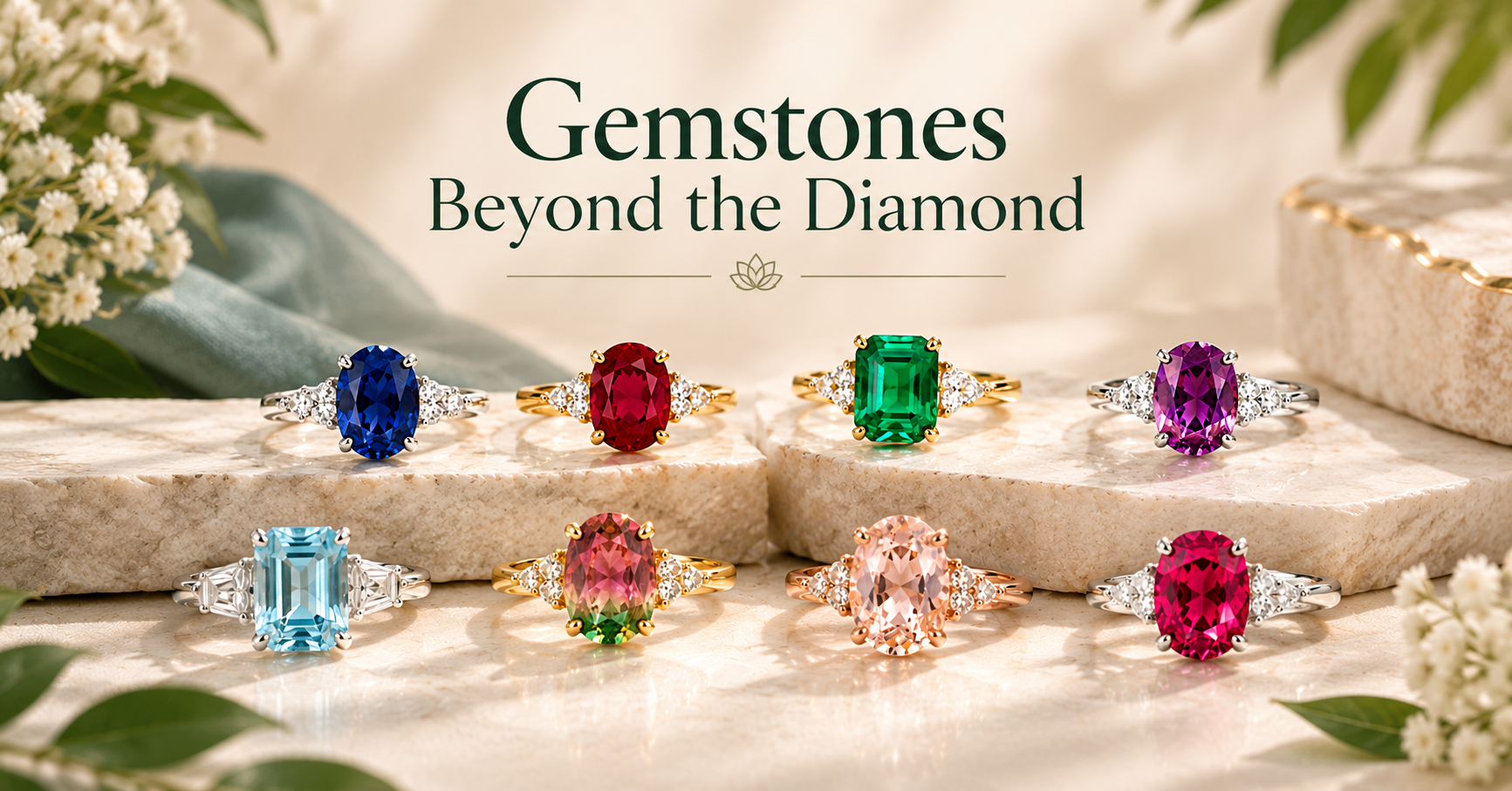
Diamonds may have a timeless place in jewellery, but they are no longer the only way to add elegance and colour to a jewellery collection. Today, coloured gemstones are becoming a favourite for people who want jewellery that feels more personal, expressive, and distinctive.
A deep blue Sapphire can create a refined and classic look. Ruby brings warmth and intensity. Emerald offers a rich green that is difficult to overlook, while Morganite and Aquamarine create softer, more delicate styles. Then there are gemstones such as Spinel, Tourmaline and Amethyst, which give jewellery lovers even more room to experiment.
What makes coloured gemstones interesting is that every stone has its own combination of colour, transparency, brilliance, durability and natural characteristics. They can work beautifully in rings, earrings, pendants, bracelets and statement jewellery.
According to the Gemological Institute of America, coloured gemstones are increasingly considered alternatives to traditional diamond engagement rings, with Sapphire, Ruby, Spinel, Aquamarine, Emerald and Morganite among the popular choices.
So, if you are looking beyond diamonds, here are eight vibrant gemstones worth knowing.
1. Blue Sapphire – Timeless, Elegant and Sophisticated
Few coloured gemstones have the same instantly recognisable appeal as Blue Sapphire.
Its deep blue colour can make a simple ring look sophisticated without being overly flashy. Sapphire is also one of the harder natural gemstones used in jewellery, with a Mohs hardness of 9. That makes it particularly suitable for rings and jewellery intended for frequent wear.
Blue Sapphire is not limited to one shade either. Depending on the stone, its colour can range from lighter blue to more saturated royal or cornflower-like tones. Colour, clarity, cut and treatment all matter when evaluating a Sapphire.
It is also a September birthstone, which makes it a meaningful option for birthday jewellery.
For buyers interested in understanding the gemstone before purchasing, explore GemRishi's Blue Sapphire collection and read the Blue Sapphire quality and buying guide.
Best for: Elegant everyday jewellery, engagement rings, formal occasions and classic styles.
2. Ruby – Bold, Warm and Full of Character
If Sapphire is associated with cool elegance, Ruby brings a completely different energy.
Ruby is the red variety of corundum, the same mineral family that includes Sapphire. Its red colour is primarily associated with chromium. Like Sapphire, Ruby has a Mohs hardness of 9, giving it good resistance to scratching.
The appeal of Ruby comes largely from its colour. A vibrant red Ruby can become the focal point of a ring or pendant without needing an elaborate design around it.
Ruby is also traditionally associated with passion, vitality and the Sun in Vedic astrology. These are cultural and astrological associations rather than scientifically established effects.
For jewellery buyers, however, Ruby can simply be appreciated for what it is: a durable and visually powerful coloured gemstone.
You can explore the GemRishi Ruby collection or learn more about the stone through GemRishi's Ruby gemstone guide.
Best for: Statement rings, festive jewellery, bold personal styles and meaningful gifts.
3. Emerald – Rich, Classic and Naturally Eye-Catching
Emerald has a colour that is almost impossible to confuse with anything else.
Its green appearance ranges from lighter tones to intense greens, depending on the individual stone. Emerald is a variety of beryl, the same mineral family that includes Aquamarine and Morganite. Its green colour is generally associated with trace amounts of chromium and/or vanadium.
Emerald is traditionally considered one of the classic precious coloured gemstones alongside Ruby and Sapphire.
There is one important thing to remember, though: hardness is not the same as overall durability. Emerald typically measures around 7.5–8 on the Mohs scale, but natural emeralds commonly contain inclusions and can be more vulnerable to impact than Ruby or Sapphire. GIA notes that emeralds are often treated with oil or resin to improve apparent clarity and that they require appropriate care.
That makes Emerald particularly attractive for jewellery where its colour can be enjoyed while the stone is adequately protected.
Explore the GemRishi Emerald collection or read the Emerald wearing and gemstone guide.
Best for: Sophisticated jewellery, festive occasions, statement rings and classic green gemstone designs.
4. Amethyst – Elegant Purple Without Being Overwhelming
Not every coloured gemstone needs to be bold and intense.
Amethyst is loved for its purple colour, which can range from soft lavender to deeper violet. It belongs to the quartz family and has a Mohs hardness of around 7.
Its colour makes it particularly versatile. A lighter Amethyst can work beautifully in delicate jewellery, while a deeper purple stone can create a much stronger statement.
Amethyst is also February's birthstone, making it a popular choice for personalised jewellery and birthday gifts.
One of its biggest advantages is stylistic flexibility. It can work with silver, white gold, yellow gold and other jewellery metals, depending on the look you want.
For people who want colour without the intensity of Ruby or Emerald, Amethyst can be an excellent middle ground.
Explore GemRishi's Amethyst gemstone collection for more options.
Best for: Everyday accessories, February birthstone jewellery, elegant gifts and soft statement pieces.
5. Aquamarine – Light, Fresh and Effortlessly Elegant
Aquamarine is one of the easiest gemstones to recognise by its delicate blue to blue-green colour.
Like Emerald and Morganite, Aquamarine belongs to the beryl family. Iron is responsible for its characteristic blue colour. GIA's research on beryl confirms the relationship between Aquamarine, Emerald and Morganite within this mineral family.
Compared with a deeply saturated Blue Sapphire, Aquamarine usually creates a lighter and more relaxed appearance.
That makes it particularly appealing for people who prefer understated jewellery. It can look beautiful in a simple pendant, delicate ring or pair of earrings without dominating the entire outfit.
Aquamarine has a Mohs hardness of approximately 7.5–8. It can be suitable for jewellery, but it should still be protected from sharp impacts and unnecessary abrasion.
Explore the GemRishi Aquamarine collection if you prefer a softer blue gemstone style.
Best for: Minimalist jewellery, summer styling, everyday elegance and March birthstone jewellery.
6. Morganite – Soft Pink With a Modern Romantic Feel
If you prefer pastel colours, Morganite deserves a place on your list.
Morganite is a pink-to-peach variety of beryl and is known for its soft appearance. Its colours can include light pink, peach, salmon and pinkish-orange tones. Manganese is associated with its characteristic colour.
One reason Morganite has become popular in modern jewellery is its ability to create a romantic appearance without looking overly traditional.
It also pairs naturally with warm-toned metals such as rose gold, although the right setting can make it work beautifully with other metals too.
Morganite has a Mohs hardness of approximately 7.5–8, so it can be used in rings and other jewellery when handled appropriately.
If you are considering it, take a look at GemRishi's Morganite gemstone collection and the Morganite gemological characteristics guide.
Best for: Romantic jewellery, engagement rings, soft feminine styles and modern designs.
7. Spinel – Vibrant, Versatile and Often Overlooked
Spinel is one of those gemstones that deserves more attention.
It comes in a surprisingly broad range of colours, including red, pink, orange, blue, purple and black. GIA lists Spinel at a Mohs hardness of 8, giving it good durability for many jewellery applications.
Historically, Spinel was sometimes mistaken for Ruby. In fact, some famous gemstones once identified as Rubies were later determined to be red Spinel. The famous "Black Prince's Ruby" in the British Imperial Crown is one well-known example.
Today, Spinel is valued in its own right.
Its colour variety makes it particularly interesting for people who want something less predictable. A vivid pink or blue Spinel can create a distinctive look without following the usual Ruby-Sapphire-Emerald route.
Best for: Unique jewellery, colourful statement pieces, alternative engagement rings and collectors.
8. Tourmaline – A Gemstone for Almost Every Colour
If your biggest priority is colour variety, Tourmaline is difficult to beat.
GIA describes Tourmaline as having one of the widest colour ranges of any gemstone. It can occur in green, blue, red, pink, yellow, black and several other colour combinations.
Some Tourmalines are even naturally multicoloured. Watermelon Tourmaline, for example, can show green and pink zones within the same crystal.
Tourmaline has a Mohs hardness of approximately 7–7.5, so it can be used in jewellery, although rings should receive sensible care because they are exposed to more knocks than earrings or pendants.
For someone who wants jewellery that feels truly individual, Tourmaline offers an enormous amount of creative freedom.
Best for: Artistic jewellery, colourful collections, statement pieces and people who enjoy unusual gemstones.
How to Choose the Right Coloured Gemstone for Your Style
Choosing a gemstone becomes much easier when you start with your lifestyle and personal taste, rather than simply asking which gemstone is the most valuable.
For a classic style
Choose Blue Sapphire or Emerald.
Their strong colours can create a sophisticated look that works with both traditional and contemporary jewellery.
For a bold personality
Consider Ruby or vivid Tourmaline.
These gemstones can become the centre of attention and work especially well in statement rings.
For a softer, romantic style
Morganite or Aquamarine may be a better match.
Their lighter colours can create a delicate appearance without feeling overly formal.
For something different
Look at Spinel or Amethyst.
Both provide attractive colour while giving you an opportunity to move away from the most familiar gemstone choices.
Coloured Gemstone Jewellery for Different Occasions
One of the biggest advantages of coloured gemstones is their versatility.
For everyday jewellery, Sapphire, Ruby and Spinel are practical choices because of their relatively high hardness. However, the design and setting still matter.
For special occasions, Emerald, Tourmaline and Amethyst can create more dramatic looks.
For gifts, birthstone connections can make the choice more personal. Sapphire is associated with September, Ruby with July, Emerald with May, Amethyst with February, Aquamarine with March and Tourmaline with October.
For engagement rings, durability should be considered carefully because the gemstone may be exposed to daily knocks and abrasion. GIA recommends looking beyond hardness alone and considering toughness and stability as part of overall gemstone durability.
You can also explore GemRishi's Gemstone Jewellery collection and complete gemstone collection to compare different styles.
What to Check Before Buying a Coloured Gemstone
A gemstone may look beautiful in a photograph, but there is much more to consider before buying one.
1. Check the colour
For coloured gemstones, colour is usually one of the most important quality factors. Look at hue, tone and saturation rather than simply choosing the darkest or brightest stone.
2. Understand clarity
Natural gemstones often contain inclusions. Their presence does not automatically mean the stone is poor quality. What matters is how inclusions affect transparency, appearance and durability.
3. Look at the cut
A good cut can make a gemstone look brighter and more lively. The best cut is not necessarily the most complicated one; it is the one that works well with the stone's material and colour.
4. Ask about treatments
Many coloured gemstones can undergo treatments to improve colour or clarity. Buyers should ask what treatments, if any, have been applied and whether they have been disclosed.
5. Check whether the gemstone is natural
Natural, laboratory-grown and treated gemstones can look similar but can differ significantly in origin, characteristics and value.
For higher-value stones, a suitable gemological report can provide useful information. GIA's coloured-stone reports, for example, can identify the gemstone type and indicate whether it is natural or laboratory-grown and whether detectable treatments are present.
6. Consider durability
A gemstone intended for everyday wear needs to match your lifestyle.
Ruby and Sapphire rank around 9 on the Mohs scale, Spinel around 8, Emerald, Aquamarine and Morganite around 7.5–8, Tourmaline around 7–7.5 and Amethyst around 7.
But remember: Mohs hardness measures resistance to scratching, not overall resistance to breaking or chipping.
7. Buy from a reliable source
Clear information about gemstone identity, treatment, quality and certification can make the buying process much safer.
GemRishi's complete gemstone buying guide explains important factors including natural vs synthetic gemstones, treatment, certification, quality, durability and budget.
Beyond Diamonds: The Right Gemstone Is the One That Feels Like You
The appeal of coloured gemstones is not simply that they are an alternative to diamonds. It is that they give jewellery another dimension: colour.
A Sapphire can feel timeless. Ruby can feel powerful. Emerald can look sophisticated. Amethyst can add a touch of purple elegance. Aquamarine feels fresh and understated, while Morganite brings a softer romantic character. Spinel and Tourmaline open the door to even more unusual colours.
There is no single gemstone that is perfect for everyone.
The better approach is to consider how you want your jewellery to look, how often you will wear it, what level of care you are comfortable with, and which gemstone genuinely catches your eye.
If you are exploring gemstones for jewellery or personal use, start with GemRishi's full gemstone collection and compare the colour, quality and characteristics of different stones before making your choice.
After all, moving beyond diamonds does not mean choosing something less special. It means discovering a colour and character that feels uniquely yours.
Frequently Asked Questions
1. What are the most popular coloured gemstones?
Sapphire, Ruby, Emerald, Amethyst, Aquamarine, Morganite, Spinel and Tourmaline are among the popular coloured gemstones used in jewellery.
2. Which coloured gemstone is best for everyday wear?
Sapphire and Ruby are particularly suitable because they have a Mohs hardness of 9. Spinel can also be a durable choice at around 8.
3. Are coloured gemstones more affordable than diamonds?
Some can be, but not all. Fine Rubies, Emeralds and Sapphires can be highly valuable. Price depends on colour, quality, rarity, treatment, size and origin.
4. Which gemstone is best for a colourful engagement ring?
Sapphire and Ruby are strong choices for frequent wear. Morganite and Aquamarine can also work well with suitable settings and reasonable care.
5. Is Emerald good for everyday jewellery?
Yes, but it requires more care than Ruby or Sapphire. Emeralds commonly contain inclusions and can be more vulnerable to impact.
6. What is the difference between natural and treated gemstones?
A natural gemstone forms in nature, while a treated gemstone has undergone a process intended to improve characteristics such as colour or clarity. Treatment should be disclosed when known.
7. Which gemstone has the widest range of colours?
Tourmaline is known for its exceptionally broad colour range and can occur in many colours and colour combinations.
8. How should I choose a coloured gemstone?
Start with your preferred colour and style, then consider the gemstone's durability, clarity, cut, treatment, certification and intended use.
Have Questions Regarding This Gemstone?
Connect 1-on-1 with GemRishi’s certified Vedic gemologists on WhatsApp for personalized birth chart recommendations, lab certificate verification, or custom jewelry quotes.
Gemrishi
Gemrishi is a certified gemologist and Vedic astrology scholar at GemRishi with over 15 years experience in natural gemstone origin authentication.