Do Gemstone Substitutes Really Work in Astrology? A Guide to Uparatna & Alternative Stones
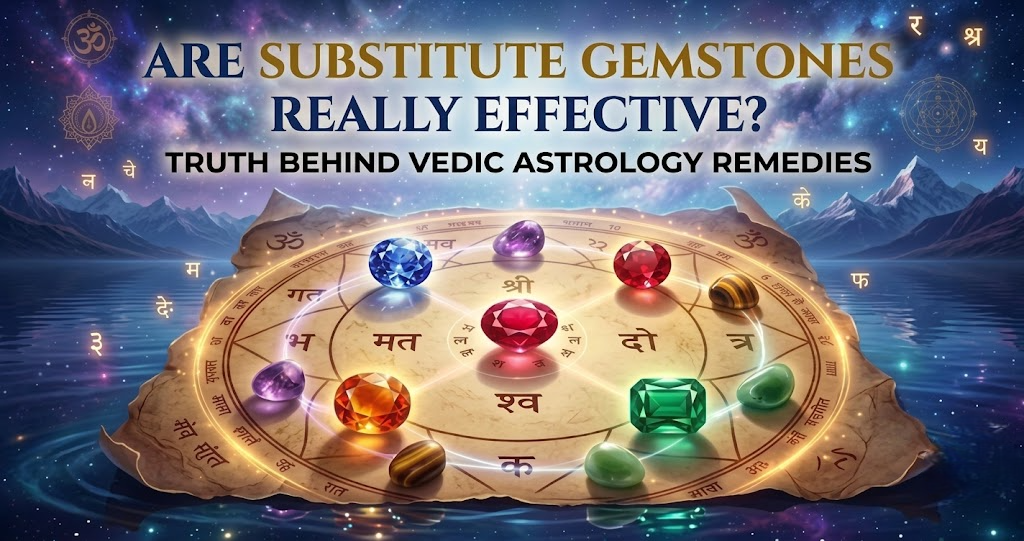
Why Do People Consider Gemstone Substitutes?
Gemstones have held a special place in Vedic astrology for centuries. Traditionally, specific gemstones are associated with particular planets and are selected according to an individual's birth chart. Stones such as Ruby, Emerald, Yellow Sapphire, Blue Sapphire, Pearl, and Red Coral are commonly discussed in Jyotish gemstone traditions.
However, there is one practical concern that many people face: high-quality natural gemstones can be expensive.
This is where gemstone substitutes, traditionally known as Uparatna, become relevant. People may consider an alternative gemstone when the primary gemstone is beyond their budget, difficult to source, or when a particular astrological tradition recommends an alternative.
For example, someone looking for a Jupiter-related gemstone may explore alternatives to Yellow Sapphire. GemRishi's guide to Natural Yellow Sapphire (Pukhraj) also discusses Citrine and Yellow Topaz as traditionally discussed alternatives.
But this raises an important question:
Do gemstone substitutes really work in astrology, or are they simply less expensive alternatives?
The answer depends on whether we look at the subject from a traditional astrological perspective, a gemstone-buying perspective, or a scientific perspective. Let's explore each aspect.
What Are Uparatna in Vedic Astrology?
Uparatna is a term commonly used for gemstones considered secondary or substitute stones in certain Vedic gemstone traditions.
In traditional gemstone astrology, primary gemstones are often referred to as Ratna, while Uparatna are considered alternative stones associated with particular planets.
The idea is relatively straightforward. If someone is traditionally advised to wear a primary gemstone but cannot obtain a suitable specimen because of price, availability, or other practical considerations, an astrologer may consider a substitute.
However, there is no single universally accepted list of Uparatna. Different astrologers and traditions may recommend different stones as substitutes.
This distinction is important because a gemstone that is considered a substitute in one tradition may not be treated in exactly the same way in another.
GemRishi's current gemstone collection includes both traditional precious gemstones and a wide range of semi-precious stones, including Ruby, Emerald, Yellow Sapphire, Blue Sapphire, Pearl, Red Coral, Citrine, Amethyst, Peridot, Garnet, Opal, and others.
Original Gemstones vs Substitute Gemstones
A primary gemstone is traditionally considered the principal gemstone associated with a particular planet. An Uparatna, on the other hand, is generally considered an alternative within a particular astrological tradition.
There can also be significant differences in their physical and gemological properties.
For example, Emerald and Peridot are both green gemstones, but they are different mineral species with different chemical compositions, hardness, appearance, inclusions, and market values.
GemRishi's article on How to Choose the Right Gemstone highlights factors such as gemstone quality, origin, treatment, certification, weight, durability, and budget when evaluating a gemstone.
Therefore, when comparing an original gemstone with a substitute, don't look only at colour or price.
Consider:
- Mineral identity
- Natural or synthetic status
- Treatments
- Colour
- Clarity
- Cut
- Durability
- Certification
- Origin, where relevant
- Price and overall quality
How Do Astrologers Traditionally Select Substitutes?
Traditionally, gemstone selection begins with the birth chart or Kundli, rather than simply choosing a gemstone based on a person's Sun sign.
An astrologer may examine the planetary placements, houses, planetary relationships, strengths, and other factors before recommending a gemstone.
The traditional process may involve questions such as:
- Which planet is being considered?
- Is strengthening that planet traditionally considered appropriate?
- Which primary gemstone represents that planet?
- Is an Uparatna appropriate according to the astrologer's tradition?
- Which particular substitute should be selected?
- What gemstone quality and weight should be considered?
This is why two people with the same zodiac sign may receive different gemstone recommendations.
A gemstone should therefore not automatically be selected simply because an online list says it is "your zodiac gemstone."
GemRishi's complete gemstone buying guide similarly emphasizes that gemstone selection involves more than simply choosing a popular or attractive stone.
Popular Gemstone Substitutes and Their Associated Planets
Different astrological traditions use different substitution systems. The following are commonly discussed traditional associations, rather than scientifically established planetary effects.
1. Ruby — Sun
Ruby (Manik) is traditionally associated with the Sun (Surya).
Some gemstone traditions discuss stones such as Red Spinel and Red Garnet as possible alternatives.
Ruby is traditionally connected with qualities such as vitality, confidence, authority, leadership, and individuality.
You can explore GemRishi's Natural Ruby collection to learn more about Ruby varieties and available gemstones.
2. Pearl — Moon
Pearl (Moti) is traditionally associated with the Moon (Chandra).
Moonstone is sometimes discussed as an alternative in gemstone traditions.
Pearl is traditionally associated with the mind, emotional sensitivity, calmness, and nurturing qualities.
3. Red Coral — Mars
Red Coral (Moonga) is traditionally associated with Mars (Mangal).
Some traditions discuss stones such as Carnelian and Red Agate as alternatives.
Red Coral is traditionally associated with courage, energy, determination, and action.
4. Emerald — Mercury
Emerald (Panna) is traditionally associated with Mercury (Budha).
Some traditions discuss Peridot and Green Onyx among possible alternatives.
GemRishi specifically discusses Peridot as an alternative to Emerald, while also explaining that gemstone recommendations should be considered within the relevant astrological tradition.
Emerald is traditionally associated with communication, intellect, learning, analytical ability, and business skills.
5. Yellow Sapphire — Jupiter
Yellow Sapphire (Pukhraj) is traditionally associated with Jupiter (Guru).
Citrine (Sunela) and Yellow Topaz are among the stones discussed as traditional alternatives in some gemstone practices. GemRishi's Yellow Sapphire guide specifically identifies these stones as affordable alternatives to Yellow Sapphire.
Yellow Sapphire is traditionally associated with wisdom, education, prosperity, knowledge, and spiritual development.
If you are comparing natural Yellow Sapphire with alternative stones, GemRishi's Yellow Sapphire buying and identification guide provides additional information about quality, treatments, and identification.
6. Diamond — Venus
Diamond is traditionally associated with Venus (Shukra).
Depending on the tradition, stones such as White Sapphire, White Zircon, and Opal may be discussed as alternatives.
For example, GemRishi's comparison of White Sapphire, Zircon, and Opal as diamond alternatives explains that these gemstones differ considerably in hardness, appearance, durability, and value.
This is a useful reminder that a gemstone alternative should not automatically be treated as physically identical to the original gemstone.
7. Blue Sapphire — Saturn
Blue Sapphire (Neelam) is traditionally associated with Saturn (Shani).
Amethyst and Iolite are among the stones sometimes discussed as alternatives in different gemstone traditions.
Blue Sapphire has a particularly important place in Jyotish traditions, so traditional practitioners may pay close attention to its astrological suitability before recommending it.
8. Hessonite Garnet — Rahu
Hessonite Garnet (Gomed) is traditionally associated with Rahu.
Some traditions discuss other varieties of garnet as possible alternatives.
Because Rahu is treated differently from the classical planets in Vedic astrology, recommendations concerning Hessonite and its substitutes can vary between practitioners.
9. Cat's Eye — Ketu
Cat's Eye (Lehsunia), particularly Chrysoberyl Cat's Eye, is traditionally associated with Ketu.
Different traditions may suggest different alternatives, so this is an area where personalized astrological guidance can be particularly relevant if the gemstone is being considered specifically as an astrological remedy.
Do Substitutes Work the Same Way as Original Gemstones?
This is where things become more nuanced.
From a traditional astrological perspective, some practitioners believe that Uparatna can represent or support the planetary association of a primary gemstone. However, they may not necessarily regard every substitute as completely equivalent to the primary gemstone.
The strength, suitability, and role assigned to a substitute can vary considerably between traditions and astrologers.
From a scientific perspective, there is no established evidence that gemstones can influence planetary forces or reliably produce outcomes such as wealth, career success, marriage, or health improvements.
Therefore, it is useful to keep these two perspectives separate.
Traditional perspective: Uparatna are used in some forms of Vedic gemstone practice as alternatives to primary gemstones.
Scientific perspective: There is no established scientific mechanism demonstrating that gemstones alter planetary influences.
This distinction does not diminish the cultural or aesthetic importance of gemstones. It simply helps readers understand what is traditional belief and what has been scientifically established.
When Do People Traditionally Consider a Substitute?
There are several practical reasons why someone may consider an Uparatna.
1. The original gemstone is expensive
High-quality natural gemstones can become costly because of rarity, colour, clarity, origin, treatment status, and size.
A substitute may provide a more accessible option.
2. The desired gemstone is difficult to source
A particular quality or variety may not always be readily available.
3. The buyer has a specific budget
Instead of purchasing a low-quality primary gemstone simply because it is cheaper, someone may explore a suitable alternative.
4. An astrologer recommends an alternative
Some practitioners may specifically recommend an Uparatna based on the individual's birth chart and their chosen astrological tradition.
5. The person wants to understand alternatives
Modern gemstone buyers often compare stones before purchasing. Looking at alternatives can help them understand differences in price, appearance, durability, and quality.
Factors to Consider Before Wearing a Gemstone Substitute
Choosing an Uparatna should involve more than finding the cheapest alternative.
Check the gemstone's authenticity
Natural, synthetic, treated, and imitation gemstones can look similar but have very different characteristics and values.
Understand treatments
Gemstones may undergo various treatments to improve colour or clarity. A buyer should know what treatment, if any, has been applied.
GemRishi's Yellow Sapphire identification guide explains why understanding the difference between genuine Yellow Sapphire and stones such as Citrine, Yellow Topaz, glass, and synthetic sapphire is important when purchasing.
Look at certification
For valuable gemstones, an appropriate laboratory report can help establish important gemological information.
Consider durability
A beautiful gemstone isn't necessarily suitable for every type of jewellery or everyday wear. Hardness, toughness, cleavage, and care requirements matter.
Don't judge only by size
A larger gemstone isn't automatically a better gemstone. Quality is influenced by several factors.
Consider the astrological context
If you are purchasing the stone specifically for Vedic astrology, traditional practice generally recommends considering the birth chart rather than relying only on generic zodiac-based recommendations.
Common Mistakes When Choosing Gemstone Substitutes
Mistake 1: Assuming "substitute" means "identical"
An alternative gemstone may have a different mineral composition, appearance, durability, and value.
Mistake 2: Choosing based only on colour
Two gemstones may look similar but be completely different materials.
Mistake 3: Buying without checking authenticity
Synthetic and imitation stones can sometimes be marketed in ways that confuse buyers.
Mistake 4: Ignoring treatments
A gemstone's treatment status can affect its value and should be properly disclosed.
Mistake 5: Following generic zodiac advice
A gemstone traditionally associated with your zodiac sign is not automatically appropriate for every individual birth chart.
Mistake 6: Focusing only on price
The cheapest stone isn't necessarily the most suitable option, while the most expensive stone isn't automatically the right one.
Mistake 7: Expecting guaranteed results
Gemstones should not be treated as guaranteed solutions for financial, relationship, career, or health problems.
For a broader understanding of gemstone selection, GemRishi's How to Choose the Right Gemstone guide covers factors such as purpose, quality, certification, treatment, weight, durability, and budget.
7 Frequently Asked Questions About Gemstone Substitutes
1. What is an Uparatna gemstone?
Uparatna is a term commonly used for gemstones considered secondary or substitute stones in certain Vedic gemstone traditions. They are traditionally associated with particular planetary gemstones.
2. Are Uparatna as effective as original gemstones?
Traditional opinions vary. Some practitioners consider Uparatna to have a related but secondary role, while others may recommend particular substitutes depending on the birth chart and astrological system they follow. There is no scientific evidence establishing planetary effects from either type.
3. Can I wear a gemstone substitute without consulting an astrologer?
You can wear a gemstone as jewellery without an astrological consultation. However, if your purpose is specifically astrological, traditional practice generally recommends selecting the stone according to the birth chart rather than choosing one solely based on a zodiac sign.
4. What is a substitute for Yellow Sapphire?
Citrine (Sunela) and Yellow Topaz are among the stones discussed as alternatives to Yellow Sapphire in some traditions. GemRishi also discusses these alternatives in its Yellow Sapphire guide.
5. What is a substitute for Emerald?
Peridot is one gemstone discussed as an alternative to Emerald in some astrological traditions. GemRishi has a dedicated Peridot astrological guide explaining this traditional association.
6. Are gemstone substitutes cheaper than original gemstones?
They can be. Primary gemstones can become expensive depending on their quality, rarity, origin, colour, clarity, treatment status, and size. Some alternatives are more affordable, although the price of any gemstone ultimately depends on its individual characteristics.
7. Should I choose an original gemstone or an Uparatna?
There is no universal answer. The choice depends on your purpose, budget, gemstone preferences, and, if following Vedic astrology, the astrological tradition and birth-chart recommendation you are using. An Uparatna should not automatically be treated as an identical replacement for the primary gemstone.
Conclusion
Gemstone substitutes, or Uparatna, offer an interesting bridge between traditional Vedic gemstone practices and the practical realities of modern gemstone buying.
They can be considered when a primary gemstone is expensive, difficult to source, or when an astrological tradition specifically recommends an alternative. However, a substitute should not automatically be considered identical to the original gemstone.
The most important thing is to understand what gemstone you are buying, how it differs from the primary stone, whether it is natural or treated, and why it is being recommended.
If you are exploring gemstones for astrological purposes, it is also useful to separate traditional beliefs from scientific evidence. Gemstones can have cultural, historical, spiritual, and aesthetic significance, but they should not be presented as guaranteed solutions to life's challenges.
Whether you choose a primary gemstone or a traditional substitute, make an informed decision based on authenticity, quality, certification, budget, personal purpose, and—where relevant—your birth chart.
Explore the full range of GemRishi certified natural gemstones to compare traditional astrological gemstones and alternative stones.
Have Questions Regarding This Gemstone?
Connect 1-on-1 with GemRishi’s certified Vedic gemologists on WhatsApp for personalized birth chart recommendations, lab certificate verification, or custom jewelry quotes.
Gemrishi
Gemrishi is a certified gemologist and Vedic astrology scholar at GemRishi with over 15 years experience in natural gemstone origin authentication.