Which Gemstone Is Suitable for Me? How to Choose the Right Gemstone by Rashi, Birth Date & Astrology
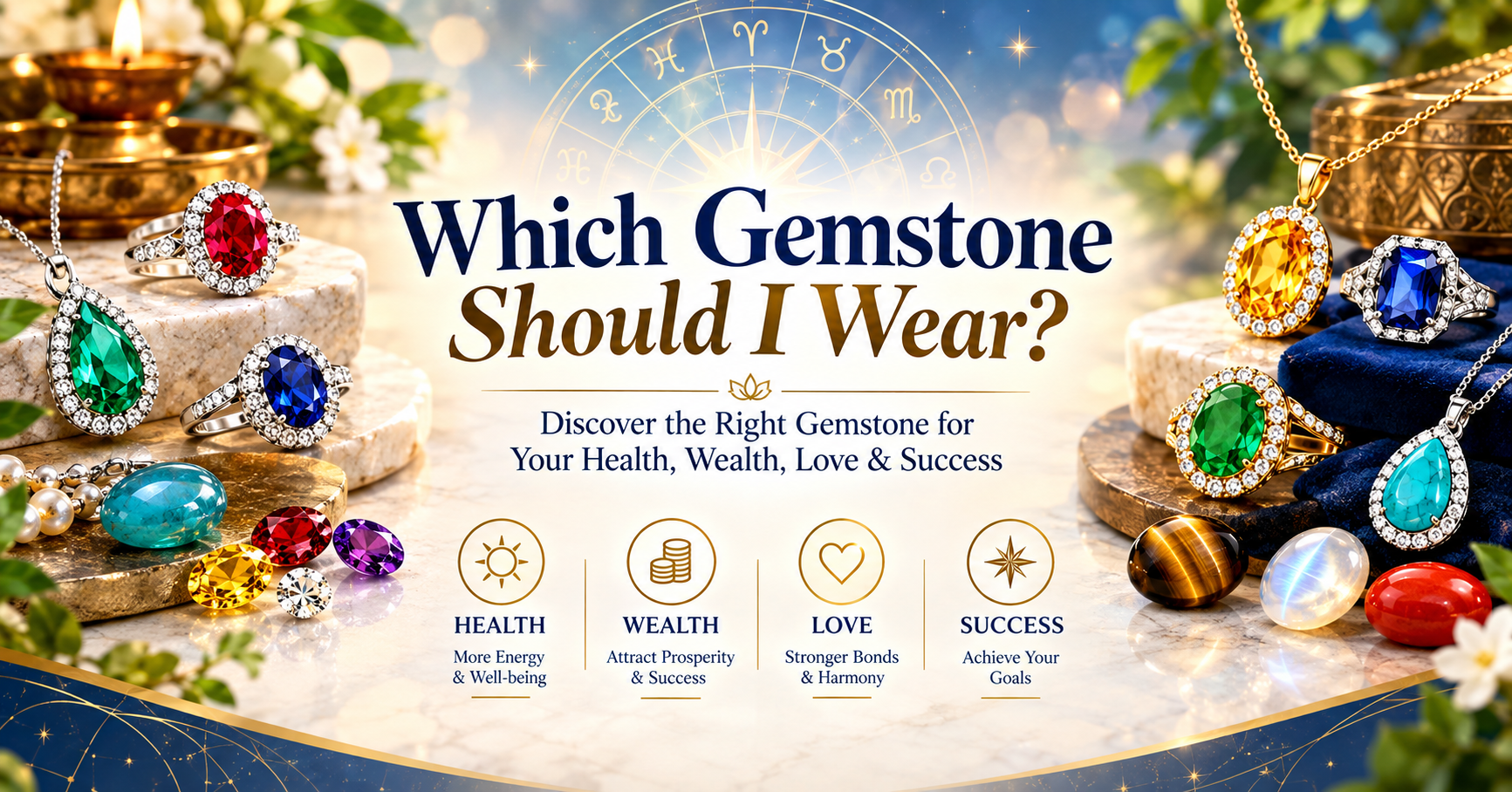
Choosing a gemstone can be exciting, but it can also become confusing very quickly. With Ruby, Emerald, Yellow Sapphire, Blue Sapphire, Pearl, Red Coral and many other gemstones available, most people eventually ask the same question: Which gemstone is suitable for me?
The answer depends on why you want the gemstone in the first place. If you are buying a gemstone for jewellery, your personal taste, colour preference, quality and budget may be the most important factors. If you are interested in a gemstone for traditional Vedic astrology, the selection can be more personal and may involve your Rashi, birth date, exact birth time, birthplace and birth chart.
Gemstones are traditionally associated with different planets in Vedic astrology. Ruby is associated with the Sun, Pearl with the Moon, Red Coral with Mars, Emerald with Mercury, Yellow Sapphire with Jupiter, Diamond with Venus, Blue Sapphire with Saturn, Hessonite with Rahu and Cat's Eye with Ketu. But this does not mean that everyone should wear the gemstone associated with their zodiac sign. Traditional gemstone selection generally looks at the individual's horoscope and planetary relationships before recommending a stone.
So, instead of simply asking which gemstone is the luckiest, it is better to understand how gemstone selection actually works.
What Should You Consider Before Choosing a Gemstone?
Before looking at gemstone colours or prices, ask yourself one simple question: Why do I want this gemstone?
If you want a gemstone for a ring, pendant or other jewellery, you have much more freedom to choose according to your personal style. You might love the deep green of Emerald, the rich red of Ruby or the soft lustre of Pearl. In this situation, colour, clarity, cut, durability, size and budget become important.
If you are looking for an astrological gemstone, the process is different. Traditional Vedic astrology may consider your birth chart and the planets associated with it before a gemstone is recommended.
This distinction is worth remembering because a gemstone that looks beautiful on your hand is not automatically an astrological recommendation, and a gemstone traditionally associated with your zodiac sign may not necessarily be the one selected after examining your complete horoscope.
For a detailed introduction to gemstone selection, you can explore the GemRishi Gemstone Buying Guide.
Can Your Birth Date Help You Choose a Gemstone?
Your birth date is an important starting point when exploring gemstones through astrology. However, your date of birth alone may not provide the complete information needed for a personalized recommendation.
Traditional Vedic astrology uses the birth date along with the exact time and place of birth to create a birth chart. This is important because two people born on the same date can have different planetary positions if they were born at different times or locations.
That is why a general online recommendation based only on your birthday should be treated as a starting point rather than a complete astrological assessment.
If you are choosing a gemstone specifically according to astrology, your complete birth details can provide a much clearer picture.
How Does Rashi Influence Gemstone Selection?
Rashi, commonly referred to as the Moon sign, is frequently used when discussing gemstones in Vedic astrology. This is why you will often see searches such as “best gemstone according to Rashi” or “which gemstone should I wear according to my Rashi?”
Rashi can provide useful general guidance, but it is only one part of a birth chart. A person's Lagna, planetary positions, house relationships and dasha periods can also be considered.
So, if you are researching gemstones according to your Rashi, it is helpful to see the recommendation as a starting point rather than an absolute answer.
Why Does Your Lagna or Ascendant Matter?
Your Lagna, or Ascendant, is another important part of traditional Vedic astrology. It is used to determine the houses of the birth chart and helps establish how different planets relate to those houses.
This is one reason why two people with the same Rashi may not necessarily receive the same gemstone recommendation.
For example, a planet may have a different role in two different birth charts. Traditional gemstone selection therefore looks beyond the zodiac sign and considers the broader structure of the horoscope.
How Does Your Birth Chart Determine a Suitable Gemstone?
Once the birth chart is prepared, traditional astrologers may examine several factors before suggesting a gemstone. These can include planetary strength, house placement, planetary lordship, aspects, conjunctions and current or upcoming dasha periods.
The basic idea is that the gemstone is traditionally connected with a particular planet. Therefore, the question becomes less about “Which gemstone is popular?” and more about “Which planetary gemstone is considered appropriate for my chart?”
This is why a gemstone that is traditionally recommended for one person may not necessarily be recommended for another person with a similar zodiac sign.
People who want to explore a birth-chart-based approach can also visit the GemRishi Astrological Gemstone Recommendation page.
Understanding the Nine Traditional Planetary Gemstones
The nine commonly discussed planetary gemstones are connected with the Navagraha tradition of Vedic astrology.
Ruby, or Manik, is traditionally associated with the Sun and is often connected with leadership, confidence and authority. If you are researching Ruby for jewellery or traditional purposes, you can explore the GemRishi Ruby Collection.
Pearl, or Moti, is associated with the Moon and is traditionally connected with emotions, sensitivity and the mind. Its naturally soft lustre also makes it a popular jewellery gemstone. You can explore the GemRishi Pearl Collection.
Red Coral, known as Moonga, is traditionally associated with Mars. It is an organic gemstone and is commonly discussed in relation to courage, energy and determination. See the GemRishi Red Coral Collection to explore available options.
Emerald, or Panna, is traditionally associated with Mercury. Mercury is traditionally connected with communication, learning, reasoning and intellect. Emerald is also one of the most admired green gemstones in jewellery. Explore the GemRishi Emerald Collection.
Yellow Sapphire, or Pukhraj, is traditionally associated with Jupiter. Jupiter is traditionally connected with knowledge, wisdom and expansion. If you are researching Pukhraj, visit the GemRishi Yellow Sapphire Collection.
Diamond is traditionally associated with Venus and is particularly valued in jewellery for its brilliance and durability.
Blue Sapphire, or Neelam, is traditionally associated with Saturn. Because of its important place in traditional astrology, people often want to know whether it is suitable for their individual horoscope before wearing it. You can explore the GemRishi Blue Sapphire Collection.
Hessonite, or Gomed, is traditionally associated with Rahu, while Cat's Eye, or Lehsunia, is associated with Ketu. These gemstones are generally discussed in relation to particular birth-chart conditions rather than simply being chosen by zodiac sign.
Which Gemstone Is Suitable for Each Zodiac Sign?
Zodiac-based gemstone guides can be useful when you are just beginning your research. They provide a simple way to understand the traditional connection between zodiac signs, planets and gemstones.
However, a zodiac sign should not necessarily be treated as the final answer. Your complete birth chart contains information that a general Sun-sign or Rashi recommendation does not capture.
If you are choosing a gemstone purely for jewellery, you also do not have to follow an astrological recommendation. Your personal preference can be the deciding factor.
How to Choose a Natural Gemstone
Once you have identified the gemstone you are interested in, the next question is quality.
A gemstone can be natural, synthetic or treated, and these terms are not interchangeable. A natural gemstone forms naturally, while a synthetic gemstone is created in a laboratory. A natural gemstone can also have undergone treatment to improve its appearance.
This is particularly important when buying an expensive gemstone online. Two stones can look very similar but have very different values depending on their origin, treatment and quality.
GemRishi's buying guidance recommends checking natural status, treatment, certification, origin, weight, durability and price before purchasing.
Natural vs Treated Gemstones: What Should You Know?
One common misunderstanding is that natural and untreated mean exactly the same thing.
They do not.
A gemstone can be natural but heated or otherwise treated. Treatments are used for different gemstones and can improve characteristics such as colour or clarity. GIA notes that treatments are common in coloured gemstones and can include processes such as heating, filling and other enhancements.
For buyers who specifically prefer untreated gemstones for traditional astrological purposes, treatment disclosure becomes especially important.
You can learn more about this distinction through GemRishi's guide on Unheated vs Untreated Gemstones.
Why Does Gemstone Certification Matter?
When you buy a valuable gemstone, appearance alone is not enough to establish what the stone actually is.
A reputable laboratory report can provide information about gemstone identity, whether it is natural or synthetic, detectable treatments and, for certain stones, origin. GIA's coloured-stone reports, for example, include gemstone type, natural or synthetic status, detectable treatments, measurements, weight, colour and other identifying information.
For this reason, certification can give buyers additional confidence when comparing gemstones, particularly for higher-value purchases.
You can browse the GemRishi certified natural gemstone collection and review the certification and product information before purchasing.
How Much Should You Spend on a Gemstone?
The most expensive gemstone is not automatically the right gemstone for you.
Price can vary considerably depending on the gemstone's quality, colour, clarity, size, treatment, origin and certification. Your purpose also matters. Someone buying a gemstone for everyday jewellery may have very different requirements from someone searching for a particular gemstone for traditional astrology.
Instead of focusing only on carat or ratti weight, look at the complete picture and make sure the price makes sense for the gemstone's documented characteristics.
Common Mistakes People Make When Choosing a Gemstone
One of the most common mistakes is choosing a gemstone only because it is associated with a zodiac sign. Another is buying a stone simply because someone calls it a “lucky gemstone.”
Buyers also sometimes overlook treatment information or assume that the word “natural” automatically means “untreated.” Others focus entirely on price and forget to check certification, gemstone identity or seller transparency.
Another easy mistake is confusing gemstones that have similar colours. A yellow gemstone is not automatically Yellow Sapphire, and a green gemstone is not automatically Emerald. Gemstone identification matters.
How to Choose a Gemstone Online
Buying a gemstone online can be convenient, but it is worth taking a few extra moments to check the details before placing an order.
Look at the gemstone description, weight, measurements, treatment information and certification. If the gemstone is being purchased for astrology, make sure you have established its traditional suitability before focusing on the purchase itself.
A transparent seller should provide enough information for you to understand what you are buying rather than asking you to rely only on photographs or broad claims about authenticity.
So, Which Gemstone Is Suitable for You?
There is no single gemstone that is automatically suitable for everyone.
If you want a gemstone for jewellery, start with what you genuinely like and then consider quality, authenticity, durability and budget.
If you are interested in traditional Vedic astrology, your birth date, exact birth time, birthplace, Rashi, Lagna and planetary positions can all become part of the selection process.
The most sensible approach is to first understand your purpose, then identify the gemstone that fits that purpose, and finally verify its quality and authenticity before buying it.
A gemstone is a long-term purchase for many people, so there is no reason to rush. Take the time to understand the stone, ask the right questions and choose something that genuinely fits your needs.
Explore the complete GemRishi gemstone collection to discover natural gemstones for jewellery and traditional astrological interests.
Frequently Asked Questions
Which gemstone is suitable for me according to my birth date?
Your birth date can be a starting point, but traditional Vedic astrology generally considers the exact birth time, birthplace and complete birth chart for a more personalized recommendation.
Which gemstone should I wear according to my Rashi?
Rashi can provide general guidance, but it is only one part of the birth chart. Traditional gemstone selection may consider the Lagna and planetary positions as well.
Can I choose a gemstone according to my zodiac sign?
Yes, zodiac-based recommendations can help you begin your research. However, they should not necessarily be treated as personalized astrological advice.
Which gemstone is associated with Jupiter?
Yellow Sapphire, or Pukhraj, is traditionally associated with Jupiter.
Which gemstone is associated with Mercury?
Emerald, or Panna, is traditionally associated with Mercury.
Which gemstone is associated with Saturn?
Blue Sapphire, or Neelam, is traditionally associated with Saturn.
Is a natural gemstone always untreated?
No. A gemstone can be natural and still have undergone treatment. Natural origin and treatment status are separate characteristics.
How can I check whether a gemstone is genuine?
A recognized gemological laboratory report can provide useful information about gemstone identity, natural or synthetic status and detectable treatments.
Should I buy an untreated gemstone for astrology?
Some people following traditional astrological practices prefer natural, untreated gemstones. If that is important to you, check the treatment information and supporting laboratory documentation before purchasing.
Where can I buy natural gemstones online?
You can explore the GemRishi natural gemstone collection and review the available gemstone and certification information before making your purchase.
Disclaimer: Astrological gemstone recommendations are based on traditional Vedic astrology and cultural beliefs. They are not scientifically established methods for predicting outcomes or treating medical or psychological conditions.
Have Questions Regarding This Gemstone?
Connect 1-on-1 with GemRishi’s certified Vedic gemologists on WhatsApp for personalized birth chart recommendations, lab certificate verification, or custom jewelry quotes.
Gemrishi
Gemrishi is a certified gemologist and Vedic astrology scholar at GemRishi with over 15 years experience in natural gemstone origin authentication.