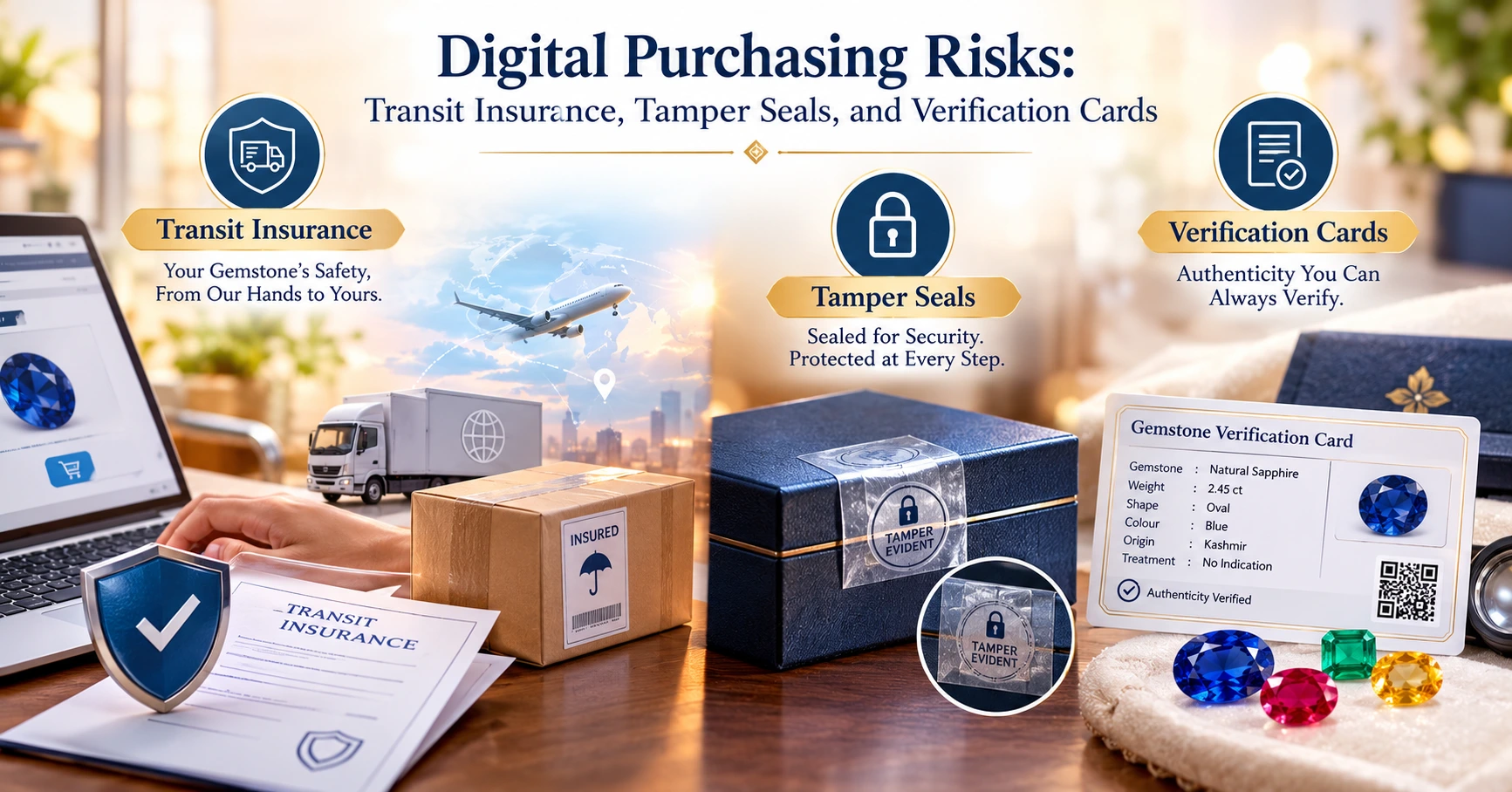
Digital Purchasing Risks: Transit Insurance, Tamper Seals, and Verification Cards
Buying a gemstone online involves more than choosing the right colour, carat weight, or price. Once an order is placed, the gemstone must travel safely from the seller to the buyer, remain protected during handling, and arrive with the documentation needed to understand what has been purchased. Every step matters, particularly when the parcel contains a valuable gemstone or a piece of fine jewellery.
Three safeguards deserve particular attention: transit insurance, tamper-evident packaging, and gemstone verification cards or laboratory reports. Each addresses a different risk, and understanding these differences can help buyers make better decisions when shopping for precious stones online.
A secure delivery process does not depend on packaging alone. It also requires clear shipping terms, accurate product descriptions, reliable documentation, and a practical procedure for reporting problems. Before purchasing from an online gemstone store, knowing what to check can help protect both your money and your purchase.
Why Online Gemstone Purchases Require Extra Care
Gemstones are small, portable, and sometimes valuable relative to their size. A parcel may contain a Ruby, Emerald, Yellow Sapphire, Blue Sapphire, or a finished ring that needs careful handling throughout delivery.
Unlike shopping in a physical store, online purchasing means buyers cannot inspect the item before payment or take immediate possession of it. Photographs and descriptions help, but they cannot independently establish the condition of the parcel during transit or prove that the item received matches every claim made about it.
Potential problems include:
- A shipment being lost, delayed, or damaged during transit.
- Packaging arriving opened, torn, or apparently resealed.
- A gemstone or accompanying document being missing.
- Confusion about the stone's identity, treatment, weight, or certification.
- Uncertainty about return eligibility or the evidence needed to make a claim.
These risks do not mean online gemstone shopping is inherently unsafe. They highlight why buyers should evaluate the seller's delivery process and documentation before placing an order.
1. Transit Insurance: What Does It Protect?
Transit insurance is intended to protect against specified losses or damage while goods are being transported. For gemstone purchases, it can be an important safeguard because even a small item may have substantial financial value.
However, insured shipping should never be assumed to cover every possible problem automatically. The actual protection depends on the policy, the carrier's terms, the declared shipment value, applicable exclusions, and who is responsible for arranging the coverage.
What Should Buyers Check?
Before paying for a valuable gemstone, confirm the following details with the seller:
- Coverage period: Does protection begin at dispatch, collection by the carrier, or another defined point?
- Declared value: Is the shipment insured for the appropriate value of the purchased item?
- Covered incidents: Does the policy cover loss, theft, or transit damage, and under what conditions?
- Exclusions: Are certain types of damage, packaging problems, or delivery circumstances excluded?
- Claim responsibility: Does the seller or buyer need to contact the carrier or insurer?
- Claim deadline: How quickly must a loss or damage be reported?
- Required evidence: Are photographs, the invoice, the shipping label, or original packaging required?
These questions are particularly important for expensive gemstones and customised jewellery.
Does Insured Shipping Guarantee a Refund?
No. Insurance is not the same as a return policy or an unconditional refund guarantee. A claim may require evidence, compliance with reporting deadlines, and confirmation that the incident falls within the policy's coverage.
A seller may also offer its own resolution process for delivery problems. Buyers should read both the shipping policy and the return policy rather than assuming they provide identical protection.
For a practical example, review the GemRishi shipping policy to understand the published shipping and delivery terms. Confirm any specific transit-insurance questions with customer support before purchasing.
2. Tamper-Evident Seals: A Small Detail That Matters
A tamper-evident seal is designed to show signs of interference if packaging has been opened or altered. Depending on the packaging system, this may be a security label, a destructible adhesive seal, a numbered seal, or another feature that cannot be removed and reapplied without leaving visible evidence.
For gemstone deliveries, these seals can help buyers identify potential packaging irregularities before opening a parcel.
They are useful, but their purpose should be understood correctly.
What Can a Tamper Seal Tell You?
An intact seal may indicate that the particular sealed closure has not been visibly disturbed. A broken, lifted, mismatched, or damaged seal may justify closer inspection.
However, a seal cannot prove that a gemstone is authentic, establish its market value, or guarantee that the correct item was packed. It is one part of a broader security process, not a substitute for product documentation or laboratory testing.
How to Inspect the Parcel When It Arrives
When receiving a valuable gemstone, take a few straightforward precautions.
First, inspect the outer packaging. Look for tears, punctures, crushed corners, unexplained adhesive, or signs that the parcel has been reopened.
Next, check the seals and shipping label. If the seller has supplied a numbered seal or a specific packaging reference, compare it with the information provided in your order documents.
Then, document anything unusual. Take clear photographs of the parcel, label, and damaged or suspicious areas before opening it. If the parcel appears seriously compromised, contact the seller or carrier for instructions before proceeding.
Finally, keep the packaging. Do not immediately discard the outer box, security labels, invoice, or protective materials. They may be relevant if a shipping claim or return becomes necessary.
A continuous unboxing video can also help document the condition of the parcel and its contents. Although it does not guarantee that a claim will be accepted, it may provide useful supporting evidence.
What If the Seal Is Broken?
A broken seal does not automatically mean the gemstone has been stolen or replaced. Packaging can be damaged accidentally during transportation, and the reason may not be immediately clear.
Nevertheless, treat unexplained tampering seriously. Photograph the parcel, preserve the packaging, avoid altering relevant evidence, and notify the seller promptly. If the carrier's delivery process provides a formal damage-reporting procedure, follow it as well.
The objective is to create a clear record of what arrived and when the problem was discovered.
3. Verification Cards and Gemstone Laboratory Reports
The word verification can refer to several different documents in the gemstone trade. Understanding the difference between a seller-issued authenticity card, a product information card, an invoice, and an independent laboratory report is essential when buying precious stones online.
These documents do not all provide the same level or type of evidence.
What Is a Gemstone Verification Card?
A verification card may be supplied by a seller to record information about a gemstone and the seller's authenticity commitment. Depending on the issuer, it might include the gemstone's name, product reference, weight, purchase details, or a reference to a laboratory report.
Its usefulness depends on what it actually records and who issued it. A seller's card can be valuable for maintaining purchase records, but it should not automatically be treated as an independent gemological examination.
Before relying on a card, check:
- The gemstone's name and identifying details.
- The stated weight or measurements, where applicable.
- The seller or issuing organisation.
- Any report number or verification reference.
- Whether the card describes a guarantee, a product record, or an actual laboratory examination.
- The terms and limitations attached to the document.
If the card contains a QR code or verification number, use the official website of the issuing organisation to check it. Avoid relying solely on a screenshot, a printed logo, or a QR code that redirects to an unfamiliar website.
How Is a Laboratory Report Different?
An independent gemological laboratory report is intended to describe findings from examining a submitted gemstone or jewellery item. Depending on the laboratory and report type, it may identify the gemstone, describe its characteristics, indicate whether it is natural or laboratory-grown, and disclose detectable treatments.
For example, the Gemological Institute of America (GIA) explains that its coloured-stone reports can include gemstone identity, natural or synthetic status, detectable treatments, measurements, weight, colour, and a photograph.
A report's scope matters. Not every report covers origin, every possible treatment, monetary value, or every characteristic a buyer might want to know.
GIA also clarifies that its reports are not appraisals or guarantees of monetary value.
That distinction is important: a gemstone report helps establish what was examined and what the laboratory concluded, but it does not automatically guarantee resale value or protect against shipping loss.
How to Verify a Gemstone Report
If your gemstone arrives with a laboratory report, take a few minutes to check the document.
- Identify the issuing laboratory. Confirm the laboratory's name and official website.
- Locate the report number. Check that the number is legible and matches the document.
- Use the official verification service. For eligible GIA reports, use the official GIA Report Check service to compare the report information with the laboratory's records.
- Compare the report with the gemstone. Match the gemstone description, weight, measurements, image, or inscription where those details are provided.
- Read the findings and limitations. Check whether the report identifies the stone as natural or laboratory-grown and whether it records detectable treatments.
- Ask for clarification if anything differs. Do not assume that a mismatch is harmless or that a certificate automatically applies to the gemstone in your parcel.
A successful online report lookup verifies the corresponding record; it does not physically examine the stone you received. The item and its documentation still need to be matched carefully.
For additional guidance, explore GemRishi's gemstone certification information and its natural versus lab-grown gemstone guide.
4. Why These Three Safeguards Work Best Together
Transit insurance, tamper-evident seals, and verification documents address different parts of an online purchase. None can replace the others.
- Transit insurance may provide financial protection against specified shipping losses.
- Tamper-evident packaging helps reveal possible interference with the parcel.
- Verification cards and laboratory reports provide product information or evidence about the gemstone's identity and characteristics, depending on the document.
Consider a buyer who orders an Emerald online. The parcel arrives with an apparently intact seal and a laboratory report. The seal offers some reassurance about the packaging, while the report can help establish the identity and characteristics of the examined stone. Neither, however, proves that the parcel was insured for its full value.
Now consider a different situation: the package arrives with a damaged seal, but the gemstone and report appear to be present. The documentation may help identify the item, yet the buyer should still record the packaging damage and notify the seller if appropriate.
Finally, if a shipment is lost, a laboratory report cannot replace transit insurance. The buyer will need to follow the applicable shipping or insurance claim process.
The strongest purchasing process combines all three safeguards with a clear invoice, accurate product descriptions, transparent policies, and accessible customer support.
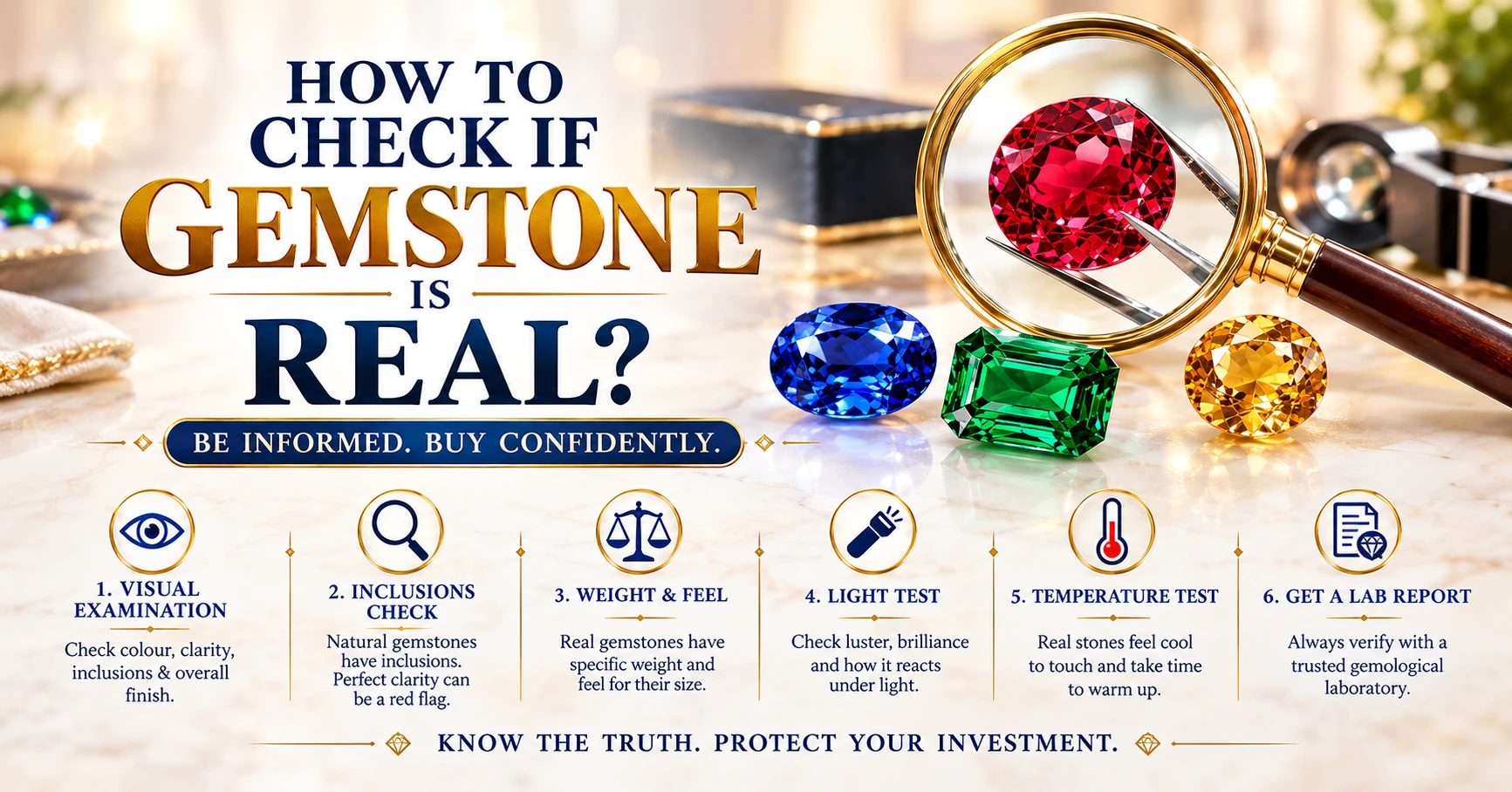
5. What to Check Before Buying a Gemstone Online
A little preparation before checkout can make delivery problems easier to handle.
Read the Shipping Policy
Check dispatch estimates, delivery arrangements, tracking availability, insurance terms, and the procedure for reporting a missing or damaged shipment. If the value of your purchase is significant, ask the seller to confirm how the shipment will be protected.
The GemRishi shipping policy is a useful starting point for understanding its published delivery arrangements.
Understand the Return and Exchange Conditions
Check how many days you have to request a return, what documentation must be retained, whether the original packaging is required, and whether customised jewellery has different conditions.
Read the applicable GemRishi return policy before ordering, and confirm any unclear terms with the company. Return eligibility and shipping-insurance claims are separate matters.
Keep Your Purchase Records
Save the order confirmation, invoice, product description, tracking number, payment receipt, and any certificate or verification card. Keep correspondence with the seller, particularly if you have asked questions about treatment, authenticity, insurance, or delivery.
These records can help you explain what was purchased and provide relevant evidence if a dispute arises.
Compare the Product Description With the Documentation
A listing may describe a gemstone as natural, treated, untreated, or associated with a particular origin. Check whether the supporting report actually addresses those claims.
For example, a report that identifies a gemstone does not necessarily establish its geographic origin unless origin determination is part of the report. Likewise, a natural gemstone may still have undergone treatment. The precise wording matters.
GemRishi's complete gemstone buying guide provides further guidance on authenticity, treatments, certification, quality, and selecting a stone that fits your purpose.
6. What to Do If Your Gemstone Delivery Has a Problem
If your order arrives damaged, appears tampered with, or contains documentation that does not match the product, avoid making assumptions before gathering evidence.
Follow these steps:
- Photograph the parcel: Capture the shipping label, exterior, seals, and visible damage.
- Record the opening process: If safe and practical, document the opening and contents without interrupting the evidence.
- Keep everything: Retain the packaging, invoice, delivery receipt, verification card, and laboratory report.
- Contact the seller promptly: Explain the issue clearly and provide relevant photographs, order details, and tracking information.
- Follow the formal process: Ask whether the seller, carrier, or insurer must handle the claim and observe any stated reporting deadline.
- Keep communication records: Save emails, messages, claim references, and written instructions.
If the gemstone's identity or treatment is in dispute, consider contacting the issuing laboratory or seeking an independent examination from a suitably qualified gemological laboratory. Do not alter, recut, clean aggressively, or otherwise modify the gemstone before the issue has been assessed.
A documented, prompt response gives the seller and relevant service provider clearer information with which to investigate the problem.
7. How to Make Safer Purchases Through GemRishi
When shopping for a gemstone, look beyond the product photograph and advertised price. Review the stone's description, certification details, shipping arrangements, and return conditions before making a decision.
You can begin with the GemRishi homepage to explore available gemstones and jewellery, then consult the gemstone certification information for certification-related details.
If you are comparing natural and laboratory-grown stones, the natural versus lab-grown gemstone guide can help clarify the terminology. For broader selection advice, read How to Choose the Right Gemstone for Yourself.
Before placing a high-value order, contact the seller if you need clarification about the particular shipment's insurance, packaging, documentation, or return eligibility. Policies can differ by product, destination, and order circumstances, so confirm the terms that apply to your purchase rather than relying on assumptions.
The goal is not simply to find a gemstone that looks beautiful. It is to understand what you are buying, how it will be delivered, and what evidence and support will be available if something goes wrong.
Conclusion: Shop With Confidence, Not Assumptions
Online gemstone shopping becomes more straightforward when buyers understand the roles of transit insurance, tamper-evident seals, and verification documents.
Insurance may protect against specified shipping losses. Tamper-evident packaging can reveal signs of interference. Verification cards and laboratory reports can provide useful purchase records or gemological information, depending on who issued them and what they contain.
The key is to avoid treating any single safeguard as a complete guarantee. Check the terms, verify the documents, inspect the parcel on arrival, and preserve your records.
Before your next gemstone purchase, take a moment to review the GemRishi shipping policy, certification information, and return conditions. A few careful checks can help you make a more informed decision and know what steps to take if a delivery problem occurs.
Frequently Asked Questions
1. What is transit insurance for gemstone purchases?
Transit insurance is coverage intended to protect goods against specified losses or damage while being transported. Its actual coverage depends on the policy, exclusions, declared value, and claim conditions.
2. Does insured shipping guarantee a full refund if my gemstone is lost?
No. Insurance claims depend on the applicable terms and evidence. A full refund is not automatic in every situation, so confirm the seller's shipping and resolution policies before ordering.
3. What is a tamper-evident seal?
A tamper-evident seal is a packaging feature designed to reveal signs of opening, removal, or interference. It helps with delivery inspection but does not prove gemstone authenticity.
4. What should I do if my gemstone parcel arrives with a broken seal?
Photograph the parcel and shipping label, preserve the packaging, document the contents carefully, and contact the seller promptly. Follow the carrier's reporting procedure if applicable.
5. What is the difference between a gemstone verification card and a laboratory report?
A verification card may record product or seller information, while an independent laboratory report documents examination findings within a defined scope. Always check the issuer and the information each document actually confirms.
6. How can I verify a gemstone certificate online?
Visit the issuing laboratory's official website, enter the report number if a verification service is available, and compare the record with the physical document and gemstone.
7. Does a gemstone certificate guarantee its market value?
No. A gemological report generally describes identifying characteristics and examination findings. It should not automatically be treated as a monetary appraisal or guarantee of resale value.
8. Should I record an unboxing video when buying gemstones online?
It is a sensible precaution, especially for valuable purchases. A continuous video may help document the parcel's condition and contents, although acceptance as evidence depends on the circumstances and applicable claim process.
9. Can I return a gemstone if its certificate does not match the stone?
The available remedy depends on the seller's return terms, the nature of the discrepancy, and applicable consumer protections. Preserve the evidence and contact the seller promptly rather than modifying the gemstone.
10. What documents should I retain after buying a gemstone online?
Keep the invoice, order confirmation, payment receipt, tracking information, product description, laboratory report, verification card, and original packaging until the purchase and any applicable return period are fully resolved.
11. Does an intact seal prove that a gemstone is genuine?
No. A seal can help indicate whether packaging has been visibly disturbed, but gemstone identity requires appropriate product documentation and, when necessary, professional gemological examination.
12. Where can I check GemRishi's shipping and certification information?
Visit GemRishi's shipping policy and certification information. Review the applicable terms for your order and contact customer support if you need clarification.
Have Questions Regarding This Gemstone?
Connect 1-on-1 with GemRishi’s certified Vedic gemologists on WhatsApp for personalized birth chart recommendations, lab certificate verification, or custom jewelry quotes.
Gemrishi
Gemrishi is a certified gemologist and Vedic astrology scholar at GemRishi with over 15 years experience in natural gemstone origin authentication.