Pitri Dosh and Gemstones: Which Stone Is Suitable for Your Birth Chart?
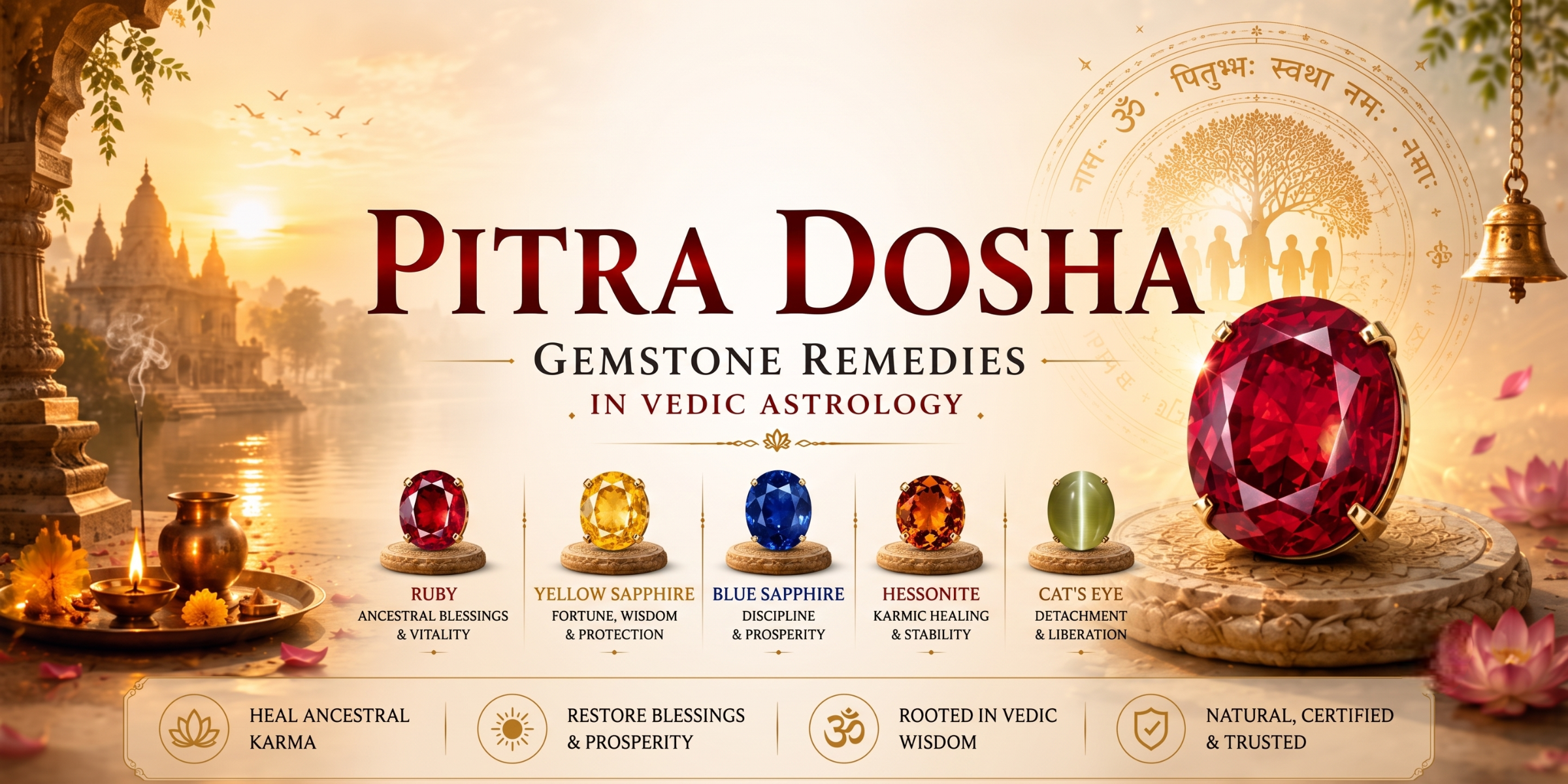
Pitri Dosh is a concept in Vedic astrology traditionally associated with ancestral influences and certain planetary combinations in a person's birth chart. In Jyotish, astrologers generally examine factors such as the Sun, Rahu, Saturn, the 9th house and its lord, along with other planetary relationships, when assessing Pitri Dosh.
It is traditionally believed that such combinations may be associated with recurring challenges in areas such as family matters, relationships, progress, finances, or delays in important life events. However, these are astrological interpretations rather than scientifically established effects.
The connection between Pitri Dosh and gemstones comes from the broader principle of Vedic astrology that gemstones are traditionally used to strengthen or support particular planetary energies.
There is no single gemstone that is universally considered the gemstone for Pitri Dosh.
In this article, we will explore Pitri Dosh, what it means in Vedic astrology, how it is identified in a birth chart, and the traditional remedies associated with it.
What Is Pitri Dosh?
Pitri Dosh (or Pitra Dosh) is a concept in Vedic astrology linked to affliction of the 9th house — traditionally associated with father and ancestors — often involving the Sun, Rahu, or Saturn.
Traditionally, it's said to reflect unresolved ancestral matters — an incomplete death ritual or disrupted shraddha (ancestral rites). Classical remedies center on ritual practice: shraddha ceremonies (especially during Pitru Paksha), tarpan (water offerings to ancestors), and specific mantras. Gemstone remedies are a later, separate practice tied to strengthening the afflicted planet, not a traditional core remedy for Pitri Dosh itself.
Astrology is a traditional belief system, not a scientifically validated one — these interpretations should be understood as cultural and religious tradition, not proven explanations for life events.
What Causes Pitri Dosh According to Vedic Astrology?
Astrologers may examine the Sun, Rahu, Saturn, the ninth house, its lord, and other planetary relationships while assessing ancestral-related combinations in a horoscope.
The Sun is particularly important in many traditional interpretations because it represents one's father, lineage, authority and connection with ancestry.
However, identifying Pitri Dosh should involve looking at the complete birth chart, rather than relying on a single planetary position found in a general online article.
This is one reason why gemstone recommendations should also be personalised.
GemRishi's gemstone recommendation service similarly explains that astrological gemstone selection is based on birth details and the individual's horoscope rather than simply choosing a stone based on a general zodiac sign.
What Are the Traditional Effects Associated With Pitri Dosh?
In traditional Jyotish interpretations, Pitri Dosh is sometimes associated with recurring challenges involving areas such as:
- Family relationships
- Delays in important plans
- Difficulties related to family continuity
- Repeated obstacles
- Financial or professional uncertainty
- A feeling of stagnation despite consistent effort
These are traditional astrological interpretations, not guaranteed outcomes.
It is also important not to assume that every family or personal difficulty is caused by Pitri Dosh. Practical circumstances, individual choices, relationships, financial conditions and many other factors can influence a person's life.
Can Gemstones Be Used for Pitri Dosh?
A gemstone is traditionally used in Vedic astrology to strengthen or support the influence of a particular planet. Therefore, there is no single gemstone that should automatically be prescribed to everyone who has Pitri Dosh.
For example, if an astrologer determines that the Sun needs strengthening in a particular birth chart, Ruby (Manik) may be considered because Ruby is traditionally associated with the Sun.
On the other hand, if another planet is more relevant to the individual's horoscope, a different gemstone may be considered.
GemRishi's current gemstone guide makes the same broader point: Ruby is associated with the Sun, Yellow Sapphire with Jupiter, Red Coral with Mars, Emerald with Mercury, Blue Sapphire with Saturn, Pearl with the Moon, Hessonite with Rahu and Cat's Eye with Ketu—but suitability depends on the individual's birth chart.
Which Gemstones May Be Considered for Pitri Dosh?
1. Ruby (Manik) – The Sun
Ruby is traditionally associated with Surya, the Sun, which holds an important place in Vedic astrology.
Because the Sun is connected with father, lineage, authority and ancestry in traditional Jyotish, some astrologers may consider Ruby when the Sun is relevant to the astrological assessment.
However, Ruby should not be worn simply because someone has been told they have Pitri Dosh.
The Sun's sign, house placement, strength, lordship and relationship with other planets should first be evaluated.
You can learn more about choosing an astrological gemstone through the GemRishi Gemstone Buying Guide.
2. Yellow Sapphire (Pukhraj) – Jupiter
Yellow Sapphire, traditionally associated with Jupiter (Guru), is another important gemstone in Vedic astrology.
Jupiter represents wisdom, knowledge, guidance, growth and spirituality in traditional interpretations.
An astrologer may consider Yellow Sapphire when Jupiter has a favourable role in a person's birth chart and strengthening it is considered appropriate.
But again, it is not a universal Pitri Dosh gemstone.
GemRishi's guide to Yellow Sapphire specifically notes that its suitability should be considered according to factors such as the ascendant, Jupiter's placement, planetary strength, house ownership and other chart factors.
3. Red Coral (Moonga) – Mars
Red Coral, or Moonga, is traditionally associated with Mars (Mangal).
Mars represents courage, action, energy and determination in Vedic astrology.
If Mars plays an important role in a particular birth chart, an astrologer may consider Red Coral as part of an astrological gemstone recommendation.
However, strengthening Mars without checking the complete horoscope is not advisable within traditional gemstone practice.
GemRishi's Red Coral guide also highlights the importance of checking the birth chart, ascendant and planetary placement before deciding whether Moonga is appropriate.
4. Blue Sapphire (Neelam) – The Gemstone of Saturn
Blue Sapphire, or Neelam, is traditionally associated with Saturn (Shani).
Saturn is connected with:discipline, responsibility, patience, hard work, karma, time, structure
Saturn can be an important planet when analysing different forms of challenging planetary combinations.
However, Blue Sapphire traditionally requires particularly careful chart-based consideration.
It should not be selected simply because Saturn appears in a Pitri Dosh-related combination.
The astrologer may examine Saturn's sign, house, lordship, aspects, conjunctions and overall strength before recommending Neelam.
For this reason, Blue Sapphire is one gemstone where personalised astrological guidance is particularly important.
5. Hessonite (Gomed) – The Gemstone of Rahu
Hessonite Garnet, commonly called Gomed, is traditionally associated with Rahu.
Rahu is considered a shadow planet in Vedic astrology and is associated with themes such as:ambition, material desires,obsession, sudden changes, illusion and confusion.
Rahu may be examined by astrologers when analysing certain Pitri Dosh combinations.
However, this does not mean that Gomed should automatically be worn for Pitri Dosh.
Rahu's placement and overall influence in the birth chart should first be evaluated.
Because Gomed is traditionally considered a powerful planetary gemstone, selecting it without understanding the horoscope may not align with traditional gemstone practice.
6. Cat's Eye (Lehsunia) – The Gemstone of Ketu
Cat's Eye, traditionally called Lehsunia or Lehsunia Ratna, is associated with Ketu.
Ketu is another shadow planet in Vedic astrology and is traditionally associated with:spirituality, deattachment, introspection, intution, past-life themes, sudden changes.
Since Ketu can be involved in different karmic and ancestral interpretations, Cat's Eye may sometimes enter discussions around Pitri Dosh.
Why Your Birth Chart Matters Before Choosing a Gemstone
Imagine two people who are both told that their charts contain Pitri Dosh.
One person may have a strong and well-placed Sun. Another may have a weak Sun. One may have a favourable Jupiter, while another may not. Their ascendants, planetary periods and house placements can also differ.
That is why simply searching for “the best gemstone for Pitri Dosh” can lead to an overly general answer.
A more useful approach is to first understand:
- Ascendant or Lagna
- Position of the Sun
- Ninth house and its lord
- Rahu and Ketu placement
- Saturn's influence
- Planetary strength
- Current Mahadasha and Antardasha
- Beneficial and challenging planetary influences
- The specific combination identified as Pitri Dosh
GemRishi's astrological gemstone recommendation page allows users to begin with their birth details to explore gemstone suitability.
Gemstone Quality Matters Too
Once an astrologically suitable gemstone has been identified, the next question is quality.
A gemstone purchased for astrological purposes should be clearly identified in terms of its natural or synthetic status, treatment, weight and certification.
GemRishi's current buying guide recommends checking factors such as natural status, treatment, certification, origin, weight, durability and seller information before purchasing an astrological gemstone.
The distinction between natural and treated gemstones can also be important for buyers who specifically prefer natural and untreated stones for traditional astrological purposes.
You can explore GemRishi's collection of certified natural gemstones here:
Explore Certified Natural Gemstones at GemRishi
Pitri Dosh Remedies Beyond Gemstones
Gemstones are only one part of the broader traditional approach.
Depending on family traditions and the guidance of a knowledgeable practitioner, people may also consider:
- Remembering and honouring ancestors
- Performing Pitru-related prayers or rituals
- Offering charity in the name of ancestors
- Feeding people or animals as part of traditional charitable practices
- Observing Amavasya-related ancestral rituals
- Performing traditional Shraddha ceremonies
- Maintaining respect for parents, elders and family traditions
These practices come from religious and cultural traditions and can have personal spiritual significance.
A gemstone does not need to replace these practices. For someone who follows the tradition, gemstones and spiritual practices may be approached as separate parts of a broader personal practice.
How to Choose the Right Gemstone for Pitri Dosh
Instead of starting with the question, “Which stone removes Pitri Dosh?”, consider a more careful process:
Step 1: Get the Birth Chart Analysed
First establish whether the astrological combination is actually present and how significant it is according to the chosen Jyotish system.
Step 2: Identify the Relevant Planet
Determine which planetary influences are involved.
Step 3: Check Gemstone Suitability
A gemstone traditionally connected with that planet should only be considered if strengthening that planet is appropriate for the individual's chart.
Step 4: Choose a Quality Stone
Check whether the gemstone is natural, its treatment status, certification, weight and other quality characteristics.
Step 5: Follow Traditional Wearing Guidance
If you decide to wear the gemstone, follow the wearing method traditionally recommended for that particular stone and planetary association.
Step 6: Buy From a Reliable Source
GemRishi currently offers natural, lab-certified astrological gemstones and provides gemstone guidance for buyers.
Final Thoughts
Pitri Dosh is a deeply traditional concept, and people approach it in different ways depending on their beliefs, family traditions and understanding of Vedic astrology.
When gemstones enter the discussion, one principle is especially important:
There is no single gemstone that is automatically suitable for every person with Pitri Dosh.
Ruby may be considered when the Sun is relevant and suitable. Yellow Sapphire may be considered when Jupiter plays an appropriate role. Red Coral may be considered when Mars is the relevant planet. Other gemstones may also enter the discussion depending on the complete horoscope.
The right approach is therefore not to search for the most popular Pitri Dosh gemstone, but to understand your birth chart first and then select a gemstone according to traditional astrological principles.
If you are exploring natural gemstones for astrological purposes, you can browse GemRishi's certified gemstone collection or use its astrological gemstone recommendation service to begin your research.
Frequently Asked Questions
1. Which gemstone is best for Pitri Dosh?
There is no single gemstone that is universally considered best for Pitri Dosh. Traditional gemstone selection depends on the planets involved and the individual's complete birth chart.
2. Is Ruby good for Pitri Dosh?
Ruby is traditionally associated with the Sun, which has an important connection with father, lineage and ancestry in Vedic astrology. However, Ruby should only be considered after checking whether the Sun is suitable for strengthening in the individual's horoscope.
3. Can Yellow Sapphire be worn for Pitri Dosh?
Yellow Sapphire is traditionally associated with Jupiter. It may be considered when Jupiter has a suitable role in the birth chart, but it should not be treated as a universal remedy for Pitri Dosh.
4. Can Red Coral help with Pitri Dosh?
Red Coral is traditionally associated with Mars. Whether it is appropriate depends on the individual's birth chart and the role of Mars. It should not be selected solely because Pitri Dosh has been identified.
5. Can I wear a gemstone without checking my birth chart?
For jewellery purposes, you can choose a gemstone based on appearance and personal preference. However, if you are wearing it specifically for an astrological purpose, traditional Vedic astrology recommends checking the birth chart before selecting the stone.
6. Are gemstone remedies for Pitri Dosh scientifically proven?
The astrological effects attributed to Pitri Dosh and gemstones belong to traditional Vedic astrology and spiritual beliefs. They are not established as scientific treatments or scientifically proven causes of life events.
7. Where can I buy a certified gemstone for astrology?
You can explore GemRishi's collection of natural, lab-certified astrological gemstones and review its gemstone selection guidance before purchasing.
Have Questions Regarding This Gemstone?
Connect 1-on-1 with GemRishi’s certified Vedic gemologists on WhatsApp for personalized birth chart recommendations, lab certificate verification, or custom jewelry quotes.
Gemrishi
Gemrishi is a certified gemologist and Vedic astrology scholar at GemRishi with over 15 years experience in natural gemstone origin authentication.