Emerald (Panna) for Intelligence: Zambian vs Colombian Emerald — Which Should You Choose?
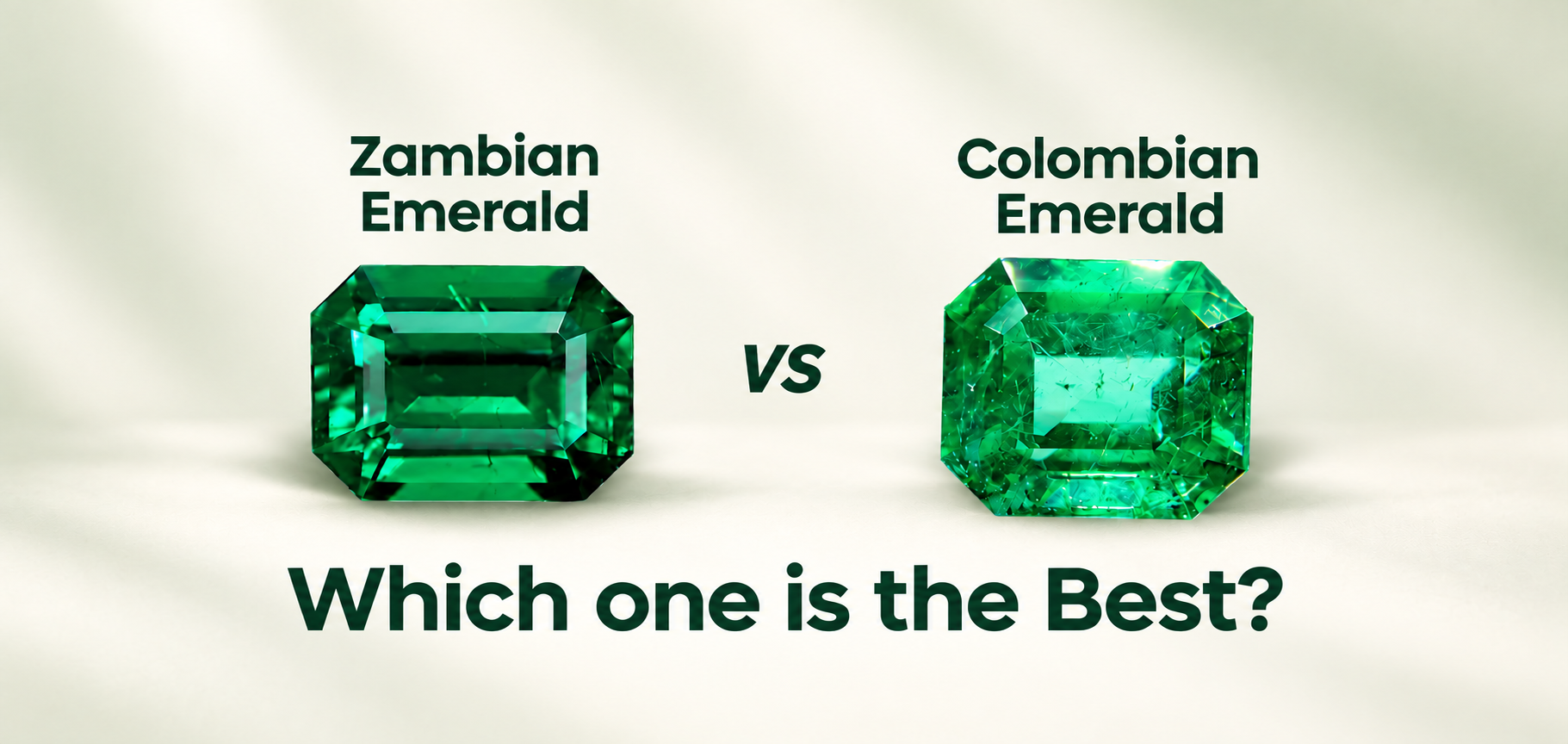
Emerald(Panna) has always had a special place in the world of gemstones. Its rich green colour makes it instantly recognizable, while in Vedic astrology, Emerald—known as Panna—is traditionally associated with Mercury (Budh).
Mercury is traditionally connected with intelligence, communication, learning, reasoning, memory, and analytical thinking. Because of these associations, Panna is often considered by people looking for a gemstone connected with education, concentration, communication, and intellectual activities. Explore GemRishi’s Emerald guide.
Both origins are well known in the emerald market, but they can produce stones with noticeably different appearances. And while origin matters, it is only one part of the story. Colour, clarity, transparency, treatment, cut, certification, and the individual quality of the stone also deserve attention.
Let’s understand the difference in a simple and practical way through this Gemrishi guide.
Why Is Emerald Associated With Intelligence?
In Vedic astrology, Emerald is traditionally associated with Mercury(Budh) planet.This planet is traditionally linked with properties such as :
- Intelligence and reasoning
- Learning and education
- Memory
- Communication
- Analytical thinking
- Writing and speech
- Logic and calculation
Panna is frequently considered by students, writers, business professionals, communicators, and people working in analytical fields.
However, these are traditional astrological associations rather than scientifically established effects. Wearing an Emerald should not be considered a scientifically proven way to increase intelligence or memory.
If you are considering Panna specifically for astrological purposes, the suitability of the gemstone is traditionally assessed through an individual's birth chart rather than simply choosing it based on profession or desired benefit. Read GemRishi’s Emerald Wearing Guide.
Colombian vs Zambian Emerald: Why Does Origin Matter?
Emeralds are found in several parts of the world, but Colombia and Zambia are two of the most recognized sources of natural Emerald.
The term "Colombian Emerald" refers to an Emerald whose geographic origin is determined to be Colombia, while "Zambian Emerald" refers to one originating from Zambia.
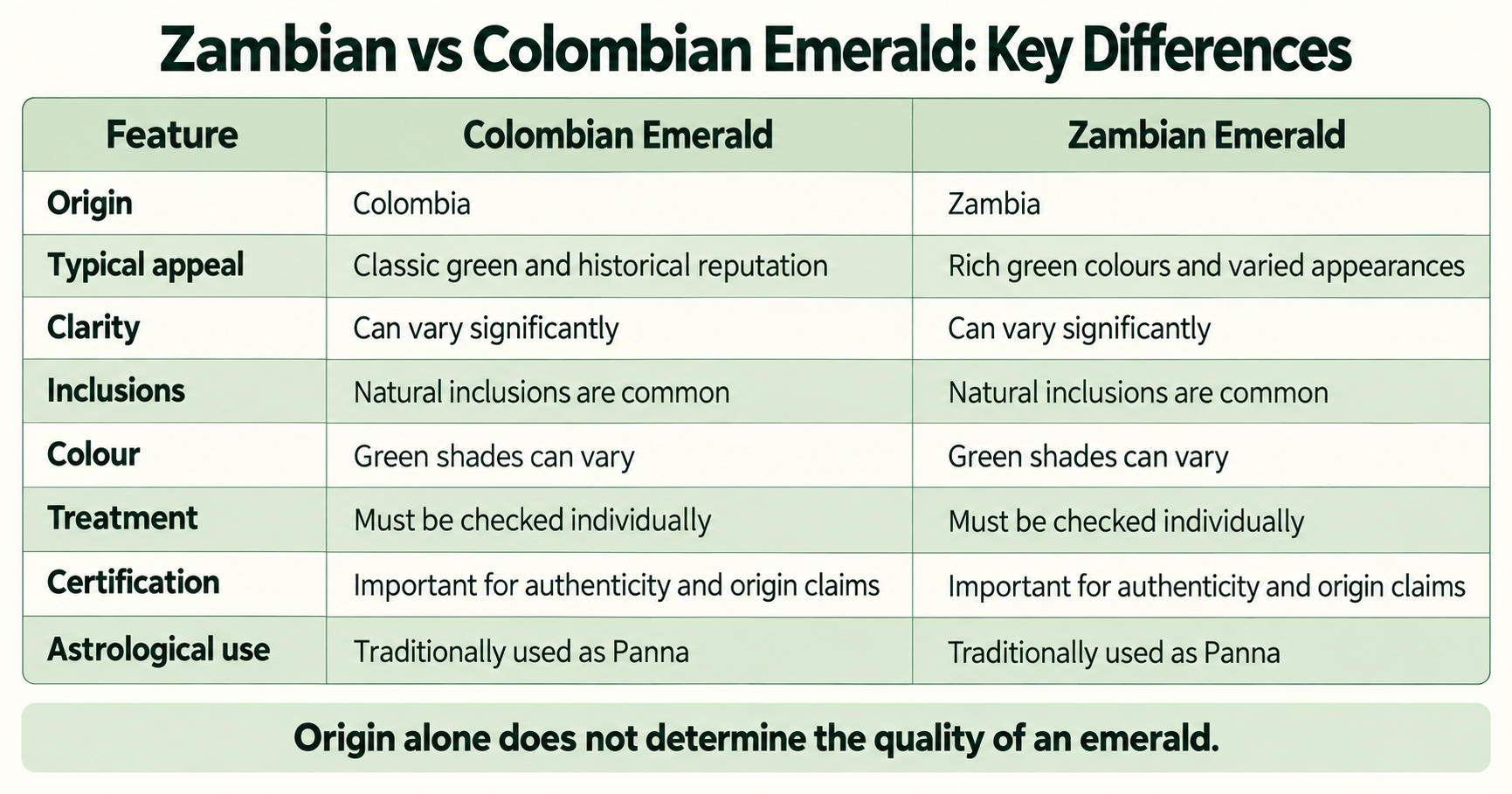
Origin can influence the typical appearance and characteristics of an Emerald, but it should not be treated as a simple quality ranking.
For example, a beautiful Zambian Emerald can be more appealing than a lower-quality Colombian Emerald, just as an exceptional Colombian stone can command more attention than an average stone from another origin.
This is why GemRishi's gemstone buying guidance recommends looking beyond origin and considering factors such as colour, clarity, treatment, cut, size, and certification.
Colombian Emeralds: What Are They Known For?
Colombian Emeralds have been admired for generations, particularly for their characteristic green colour.
Many Colombian Emeralds are associated with:
- Attractive green hues
- Good transparency in finer examples
- Natural inclusions
- Distinctive internal characteristics
- Strong historical and collector appeal
The colour of an individual Emerald can vary considerably, so it is important not to assume that every Colombian Emerald will have exactly the same shade of green.
When purchasing one, look at the actual stone rather than relying only on the word "Colombian."
A certified origin report can be particularly useful when a gemstone is being sold at a premium because of its claimed geographic origin.
Zambian Emeralds: What Makes Them Interesting?
Zambian Emeralds have also become highly respected in the international Emerald market.
They can display beautiful green colours and, depending on the stone, may offer a combination of colour, transparency, and clarity that makes them attractive to both jewellery buyers and gemstone enthusiasts. Their brilliance is different (amazing).
One of the interesting things about Zambian Emeralds is that their appearance can be quite different from one stone to another.
Some may show deeper or slightly bluish-green tones, while others can have a vivid green appearance.
This variation is one reason why comparing the actual gemstone is more useful than choosing based solely on country of origin.
GemRishi currently lists natural certified Emeralds from Zambia, including individual stones with their origin and carat information clearly provided.
Which Emerald Has Better Colour?
This is one of the most common questions buyers ask.
The answer is not simply "Colombian" or "Zambian."
Emerald colour can vary within both origins, and colour preference is also somewhat personal.
When evaluating an Emerald, look for a green colour that appears attractive, lively, and balanced.
Instead of asking only:
"Is it Colombian or Zambian?"
also ask:
"How does this particular Emerald look?"
Compare the actual colour, transparency, inclusions, cut, and overall appearance.
For more information about selecting a gemstone based on quality and purpose, see GemRishi's complete gemstone buying guide.
What About Clarity?
Natural Emeralds commonly contain inclusions. These internal characteristics are often considered part of the gemstone's natural identity.
Therefore, expecting every natural Emerald to look completely clean under magnification is unrealistic.
However, there is still a difference between attractive natural inclusions and inclusions or fractures that significantly affect transparency, appearance, or durability.
When comparing Colombian and Zambian Emeralds, look at:
- Transparency
- Visibility of inclusions
- Fractures
- Overall brilliance
- Colour distribution
- Durability
A slightly smaller Emerald with attractive colour and transparency can sometimes be more appealing than a much larger stone with poor appearance.
Does Treatment Matter?
Absolutely.
This is one of the most important things to check before purchasing Emerald.
Natural and untreated are not the same thing.
An Emerald can be:
- Natural and untreated
- Natural and treated
- Synthetic or laboratory-created
- An imitation or simulant
Some natural Emeralds undergo treatments intended to improve their appearance.
Treatment does not automatically mean that a gemstone is fake. What matters is that the treatment is properly disclosed.
If you are specifically looking for an untreated Panna for traditional astrological use, ask for clear information about the stone's treatment status and supporting certification.
GemRishi discusses the difference between natural and treated gemstones in its Natural vs Heated Gemstones guide.
Does Origin Matter More Than Quality?
For most buyers, it is better to think of origin as one part of the evaluation rather than the entire evaluation.
Imagine you are comparing two Emeralds:
Emerald A: Colombian origin, but weak colour and low transparency.
Emerald B: Zambian origin, attractive colour, good transparency, suitable cut, and reliable certification.
Simply choosing Emerald A because it is Colombian would overlook several important characteristics.
The reverse can also be true.
That is why a good Emerald buying process should consider:
- Natural origin
- Geographic origin, when relevant
- Colour
- Transparency
- Clarity
- Treatment
- Cut
- Carat weight
- Certification
- Price
Which Emerald Should You Choose for Panna?
If your purpose is traditional Vedic astrology, the decision should not be based solely on whether the stone is Colombian or Zambian.
Panna is traditionally associated with Mercury, and traditional gemstone selection considers the individual's horoscope and the suitability of Mercury in the birth chart.
After suitability has been established, the gemstone itself should be evaluated for authenticity, natural origin, treatment, colour, clarity, transparency, and certification.
So rather than asking:
"Is Colombian Panna better than Zambian Panna?"
a more useful question is:
"Which individual Emerald meets my astrological, quality, authenticity, and budget requirements?"
That approach allows you to evaluate the gemstone as a whole.
How to Buy a Natural Emerald Online
Buying an Emerald online can feel complicated, especially when you are comparing origin, carat weight, colour, and price.
Before placing an order, check:
1. Natural or Synthetic?
Confirm that the Emerald is natural if that is what you are looking for.
2. Origin
If Colombian or Zambian origin is important to you, check whether the claimed origin is supported by a laboratory report.
3. Treatment
Ask whether the stone is untreated, heated, filled, or otherwise enhanced.
4. Certification
A recognized gemological report can help verify important characteristics of the gemstone.
5. Colour and Transparency
Look closely at photographs or videos and, where possible, request additional visual information before purchasing.
6. Carat and Measurements
Do not judge an Emerald only by carat weight. Dimensions and proportions also affect how large the stone appears.
7. Seller Transparency
Choose a seller that provides clear information about origin, treatment, certification, and gemstone specifications.
You can also explore GemRishi’s certified gemstone collection when comparing natural gemstone options.
10 Useful GemRishi Resources for Emerald Buyers
If you are researching Panna before buying, these GemRishi resources can help:
- GemRishi – Natural & Certified Gemstones — Explore available gemstone options.
- Emerald for Focus, Education & Intelligence — Understand the traditional connection between Panna and Mercury.
- Emerald Wearing Guide — Learn about traditional wearing practices, weight, finger, and metal.
- Complete Gemstone Buying Guide — Understand colour, origin, treatment, certification, and quality.
- Natural vs Heated Gemstones — Learn why treatment disclosure matters.
- Emerald Care & Cleaning Guide — Learn how to clean and store your Emerald safely.
- GemRishi Emerald Collection — Browse available Panna options.
- GemRishi Journal — Explore more gemstone and Vedic astrology guides.
- Certified Gemstones — Review certified gemstone options before purchasing.
- GemRishi Home — Explore the complete natural gemstone range.
Final Thoughts: Colombian or Zambian Emerald?
Colombian and Zambian Emeralds both have their own appeal, and there is no simple rule that says one origin is automatically the right choice for every buyer.
If you are selecting Emerald for jewellery, focus on the stone's actual appearance, colour, transparency, clarity, durability, and your personal preference.
If you are considering Panna for traditional Vedic astrology, first consider its astrological suitability and then evaluate the gemstone's natural origin, treatment, quality, and certification.
Most importantly, do not buy an Emerald simply because the seller says "Colombian" or "Zambian."
Look at the complete picture.
A beautiful, authentic, properly documented Emerald with the qualities you are looking for is ultimately more meaningful than choosing an origin based only on its reputation.
And if your goal is Panna for intelligence, learning, concentration, or communication, remember that these are traditional Vedic astrological associations. Emerald can complement your spiritual or astrological practice, but it should not replace education, consistent effort, healthy habits, or professional guidance.
Frequently Asked Questions
Is Colombian Emerald better than Zambian Emerald?
No,Individual colour, transparency, clarity, treatment, cut, size, certification, and overall quality should be considered alongside origin.
Is Zambian Emerald good for Panna?
Zambian Emerald can be used as Panna when it meets the desired requirements for natural origin, quality, authenticity, and astrological suitability.
Which Emerald is best for intelligence?
In traditional Vedic astrology, Emerald (Panna) is associated with Mercury and qualities such as intelligence, learning, reasoning, memory, and communication. However, there is no scientific evidence that wearing Emerald directly increases intelligence.
Are Colombian Emeralds more expensive?
Price depends on the individual gemstone's quality and market factors. Origin can contribute to value, but it should not be considered separately from colour, clarity, transparency, treatment, size, and certification.
Do natural Emeralds have inclusions?
Yes. Inclusions are common in natural Emeralds and can be part of their natural character.
Should I buy an untreated Emerald for astrology?
Many traditional practitioners and buyers prefer natural, untreated gemstones for astrological use. If this matters to you, verify the treatment status through reliable documentation rather than relying only on a seller's description.
Is Panna the same as Emerald?
Yes. Panna is the commonly used Indian name for Emerald, particularly in the context of Vedic astrology.
Can I choose Emerald based only on my zodiac sign?
Traditional Vedic astrology generally considers more than just the zodiac sign. Birth-chart factors and the condition of Mercury may be considered when recommending Panna.
Important: The astrological associations discussed in this article are based on traditional Vedic astrology and are not scientifically proven effects.
Have Questions Regarding This Gemstone?
Connect 1-on-1 with GemRishi’s certified Vedic gemologists on WhatsApp for personalized birth chart recommendations, lab certificate verification, or custom jewelry quotes.
Gemrishi
Gemrishi is a certified gemologist and Vedic astrology scholar at GemRishi with over 15 years experience in natural gemstone origin authentication.