Maa Skandamata on Panchami: Exploring the Symbolism of Pearl and Motherhood
The fifth manifestation of Devi Durga is known as Maa Skandamata. She is fifth among Nava Durgas, thats why she is worshiped on the Fifth day of Navratri. Devi Maa is the mother of Kumara Skanda or Kumara Kartikeya also called Lord Murugan in south India. Kumar Skanda was chosen by Gods as their commander in "Deva-Sura Sangram" (the war of gods & demons) against the demons. Lord Murugan's glory has been narrated in the Puranas and he is referred to as Kumara and Saktidhar. His vehicle being peacock, so he is also called Mayuravahana.
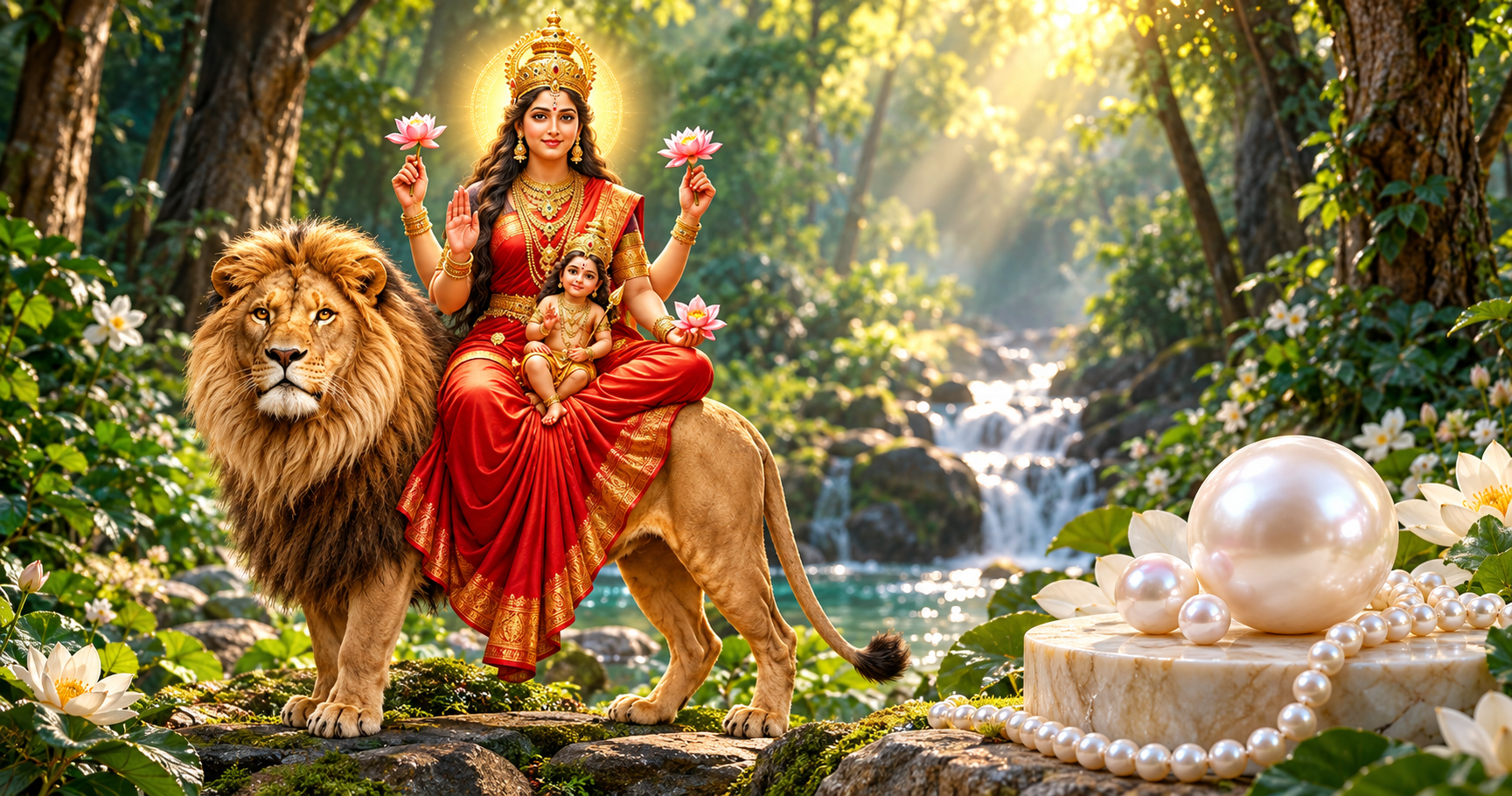
Skandamata Thus being the mother of Skanda she is Skandamata. Worshipping Skandamata on the fifth day of Navaratra has very importance for Yogis & Sadhaks. In her image the Lord Skanda in his infant form is always found. She holds him in her lap. Using a lion as a vehicle, Mother Goddess has four arms & three eyes. She holds Lord Skanda in her right upper arm and a lotus flower in her right lower hand, which is slightly raised upward. The left upper arm is in a pose to grant boon and in left lower hand, which is raised, she again holds lotus. She is Golden color. She is seated on lotus flower so she is called Padmasana.
Maa Skandamata and the Meaning of Panchami
Maa Skandamata is the fifth form of Navadurga. She is worshipped on the fifth day of Navratri, known as Panchami.
Her name itself explains her identity:
Skanda + Mata = Mother of Skanda.
Skanda is another name for Kartikeya, the son of Lord Shiva and Goddess Parvati.
In traditional depictions, Maa Skandamata holds the infant Skanda in her lap. She has four arms. Two hands hold lotus flowers, while the other hands hold her son and offer a gesture of blessing. She is commonly shown riding a lion.
The combination is meaningful.
- The lion represents courage and strength.
- The child represents care and responsibility.
- The lotus represents purity and spiritual growth.
Together, the image presents motherhood as a form of power.
The Mother and the Warrior in One Image
One of the most beautiful aspects of Skandamata is the contrast in her form.
She is a mother holding a child.At the same time, she rides a powerful lion.
Her son, Skanda, is traditionally known as a warrior and commander of the divine forces.
This creates a different understanding of strength. Strength does not always have to look aggressive. Sometimes it looks like protection, patience and care.
A mother protects before a child can protect himself.
She nurtures before he becomes independent.
She gives confidence before he learns to face the world.
This is one reason Skandamata's symbolism continues to feel relevant even today. Her story connects divine strength with something very human—the relationship between a mother and her child.
Why Motherhood Is Central to Skandamata
The image of Skandamata places motherhood at the centre of Shakti.
She is not shown only as a powerful Goddess. She is shown as a mother.
That distinction matters.
Motherhood in this symbolism is not limited to giving birth. It can also represent nurturing, protection, patience and the responsibility of helping someone grow.
A child may eventually become strong enough to face challenges alone. But that strength begins with care.
This is beautifully reflected in the traditional story of Skanda. His role as a divine warrior is connected with his upbringing and his mother's presence. In devotional interpretations, Skandamata therefore represents the nurturing force behind courage.
The Pearl Connection: Softness, Purity and the Moon
Pearl has a very different physical character from most gemstones.It is organic rather than a mineral formed deep inside the earth. Its surface has a soft lustre instead of the sharp brilliance often seen in faceted gemstones.
That softness has helped Pearl develop strong symbolic associations over time.
In Vedic astrology, Pearl or Moti is traditionally associated with the Moon, Chandra. The Moon is traditionally linked with the mind, emotions, sensitivity, nourishment and the mother.
This creates an interesting symbolic connection with Skandamata.
Skandamata represents divine motherhood.
The Moon represents maternal and nurturing qualities in traditional astrology.
Pearl represents the Moon in Vedic gemstone tradition.
The connection is therefore mainly symbolic and cultural. It should not be understood as a scriptural rule that Skandamata must be worshipped with Pearl.
Pearl as a Symbol of Motherly Energy
Pearl's white or creamy surface has long been associated with purity, softness and serenity.
Motherhood is often described in similar emotional terms—gentle, protective and comforting.
This does not mean Pearl itself creates these qualities. Rather, its traditional symbolism makes it an appropriate gemstone to discuss when exploring themes of motherhood and the Moon.
For a gemstone enthusiast, this is where the story becomes more interesting.
A gemstone can carry meaning beyond its physical beauty.
A Pearl necklace may remind someone of their mother.A Pearl ring may become a family gift.
A Pearl pendant may be chosen to mark a meaningful occasion.
The emotional value can come from the person, the memory and the intention behind the jewellery.
Maa Skandamata and the Lotus
The lotus is another important part of Skandamata's traditional imagery.
She is commonly depicted holding lotus flowers in her upper hands. In some traditions, she is also described as seated on a lotus and known as Padmasana.
The lotus is widely used in Indian spiritual symbolism.
It grows in water but rises above the surface.
Because of this, it is often associated with purity, growth and spiritual awareness.
Placed alongside the image of a mother holding her child, the lotus adds another layer to Skandamata's symbolism.
Motherhood involves growth.
A child begins completely dependent on the mother and gradually develops an independent identity.
The lotus can therefore be seen as a fitting visual symbol for the journey from nurturing to growth.
The Lion Shows That Motherhood Is Not Weakness
There is a reason the lion matters in this image.
At first glance, a mother holding a baby may appear to represent softness.
The lion changes that impression.
It brings courage, authority and protection into the picture.
The symbolism becomes clear: care and strength can exist together.
This is perhaps one of the most relatable ideas in the story of Skandamata.
A mother can be gentle with her child and fiercely protective when necessary.
Her strength does not remove her softness.
Her softness does not reduce her strength.
Pearl, Motherhood and the Modern Meaning
The connection between Pearl and motherhood can also be understood outside astrology.
Pearls are often given as gifts for important family occasions. Their classic appearance makes them suitable for jewellery that can be passed from one generation to another.
This makes Pearl naturally suited to themes of family, memory and heritage.
For someone celebrating Navratri, a Pearl piece may become a personal reminder of the qualities associated with Skandamata—care, patience, protection and unconditional affection.
It does not have to be a ritual object.
It can simply carry personal meaning.
That distinction is important when discussing gemstones. Traditional symbolism and personal meaning are different from scientifically proven effects.
Pearl in Vedic Astrology: A Traditional Perspective
For those approaching Pearl from an astrological perspective, Moti has a specific place in Vedic astrology.
It is traditionally associated with the Moon.
However, this does not mean that everyone should wear Pearl simply because it is connected with motherhood or emotional qualities.
Traditional gemstone astrology considers the individual's birth chart and planetary positions before recommending a gemstone.
If Pearl is being considered specifically for astrological use, it is better to separate that decision from the spiritual symbolism of Navratri.
The two ideas can complement each other, but they are not the same thing.
Choosing a Pearl for Jewellery
If your interest in Pearl is primarily jewellery, the decision can be much simpler.
Look at the things that matter to you:
- Natural appearance
- Lustre
- Shape
- Surface quality
- Size
- Jewellery design
- Comfort
- Budget
You can explore the GemRishi Pearl collection when looking for Pearl jewellery or gemstone options.
For someone interested in the symbolism behind Pearl, the GemRishi Pearl guide offers more information about its traditional connection with the Moon.
You can also read the GemRishi Pearl Wearing Vidhi guide if you are considering Pearl specifically for traditional astrological use.
A Different Way to Look at Skandamata
The story of Skandamata does not need to be understood only through rituals.
It can also be understood through everyday life.
A mother helping her child take the first step.
A parent supporting a child's education.
Someone caring for an elderly family member.
A person protecting what they love while giving it space to grow.
These simple acts reflect the broader idea of nurturing.
That is why the image of Skandamata remains powerful.
She holds a child in her arms, but she is not shown as powerless.
She sits on a lion.
The message is simple: love can protect, and care can create strength.
Pearl as a Reminder, Not a Promise
It is easy for gemstone articles to make large promises about what a stone can do.
A more meaningful approach is to look at symbolism.
Pearl does not need exaggerated claims to be valuable.
Its natural beauty, history and association with the Moon already give it a rich cultural identity.
When placed beside Skandamata's symbolism, Pearl can serve as a reminder of qualities such as softness, care, purity and emotional connection.
These meanings come from cultural and astrological traditions. They should not be treated as medical or scientifically proven effects.
Final Thoughts
Maa Skandamata represents one of the most tender expressions of Shakti.She is the mother who holds her child close.She is also the Goddess who rides a lion.
That combination makes her symbolism powerful. It shows that motherhood is not simply about affection. It also involves courage, responsibility and protection.
Pearl adds another layer to this theme.
Through its traditional connection with the Moon, Moti has long been associated with nurturing, emotions and the mother. Its soft lustre also reflects the gentler side of this symbolism.
So, on Panchami, the connection between Skandamata, motherhood and Pearl can be understood as a meeting of three ideas: care, purity and strength.
Not as a promise.
Not as a superstition that must be followed.
But as a meaningful part of India's long tradition of spiritual and gemstone symbolism.
Frequently Asked Questions (FAQs)
1. Who is Maa Skandamata?
Maa Skandamata is the fifth form of Goddess Durga worshipped during Navratri. She is known as the mother of Skanda, or Lord Kartikeya.
2. On which day is Maa Skandamata worshipped?
Maa Skandamata is traditionally worshipped on the fifth day, or Panchami, of Navratri.
3. What does Maa Skandamata symbolize?
Maa Skandamata symbolizes motherhood, nurturing, protection, courage and strength. Her form shows that gentleness and power can exist together.
4. Why is Maa Skandamata shown holding Lord Kartikeya?
She is shown holding Lord Kartikeya because her identity is closely connected with her role as his mother. The image represents maternal care, protection and nurturing.
5. What is the connection between Pearl and the Moon?
In traditional Vedic astrology, Pearl (Moti) is associated with the Moon (Chandra). The Moon is traditionally connected with emotions, nurturing and maternal qualities.
6. Is Pearl associated with motherhood?
Yes. In traditional Indian symbolism and astrology, Pearl's connection with the Moon gives it an association with nurturing, emotions and maternal energy.
7. Should Pearl be worn during Navratri?
Pearl does not have to be worn during Navratri. It can be worn as jewellery or considered for traditional astrological purposes based on individual preferences and beliefs.
Have Questions Regarding This Gemstone?
Connect 1-on-1 with GemRishi’s certified Vedic gemologists on WhatsApp for personalized birth chart recommendations, lab certificate verification, or custom jewelry quotes.
Gemrishi
Gemrishi is a certified gemologist and Vedic astrology scholar at GemRishi with over 15 years experience in natural gemstone origin authentication.