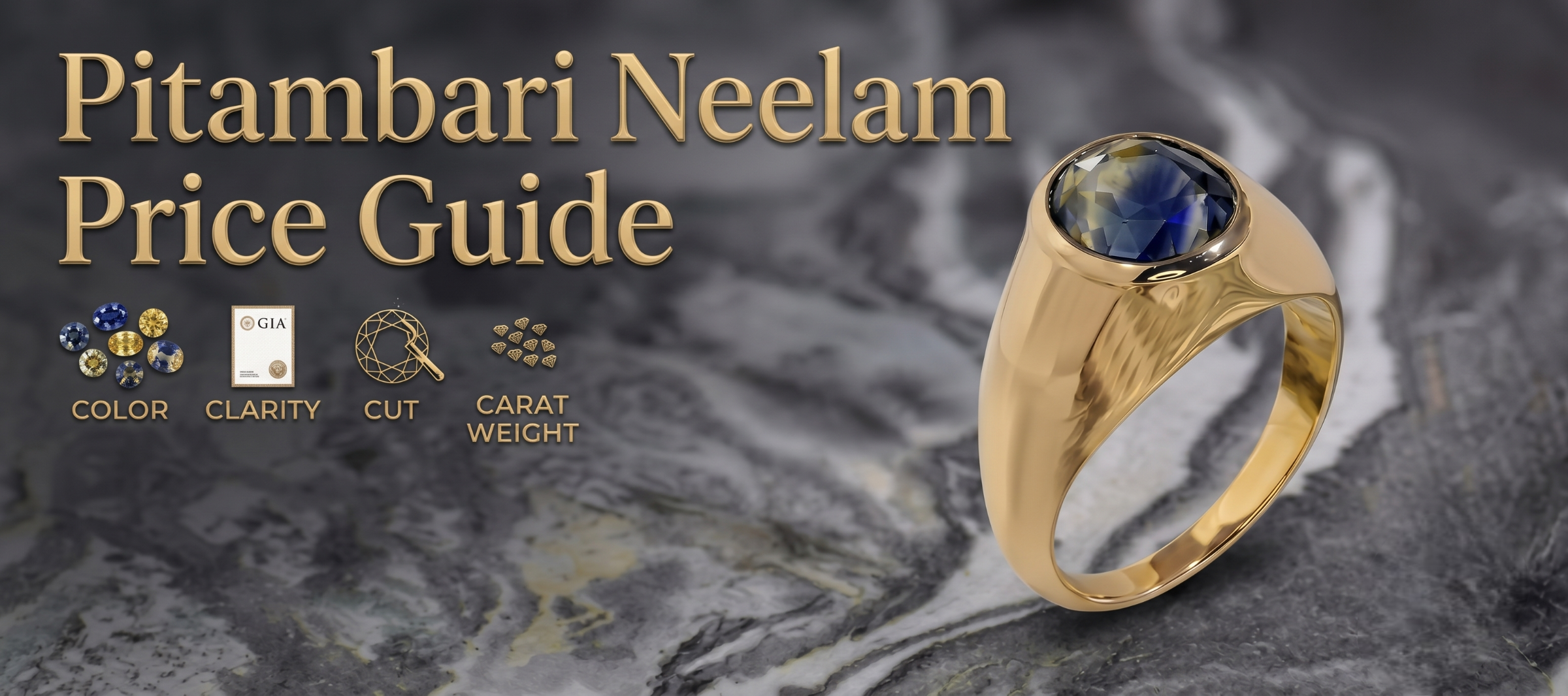
Which Finger Is Best to Wear Pitambari Neelam? Complete Guide to Wearing Pitambari Neelam
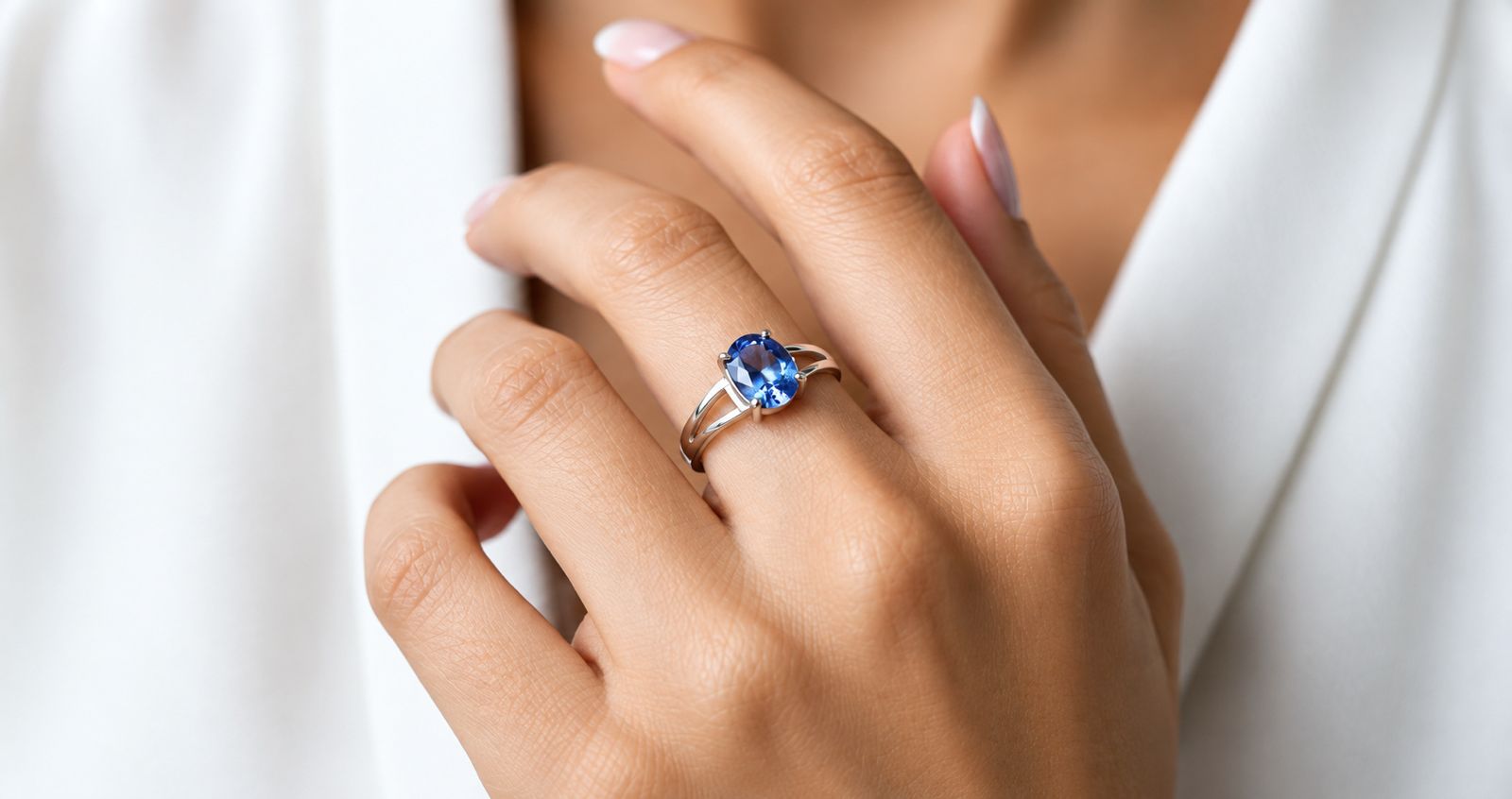
Choosing a gemstone for astrological purposes is not only about finding a beautiful stone. The way it is worn can also be an important part of the traditional and astrological. purposes. This is especially true for Pitambari Neelam, a distinctive bi-colour sapphire that naturally displays both blue and yellow shades.
Because of its unusual colour combination, Pitambari Neelam is traditionally associated with both Shani (Saturn) and Guru (Jupiter). This is also what makes its wearing method slightly different from that of a conventional Blue Sapphire or Yellow Sapphire.
If you are considering wearing this gemstone, one of the first questions that naturally comes up is: Which finger is best to wear Pitambari Neelam?
The middle finger is commonly recommended because of its traditional association with Saturn. However, the answer is not always that simple. The intended astrological purpose and an individual's birth chart can influence the final recommendation.
This guide is all about the wearing methods and all about Pitambari Neelam(Bi-Colour Sapphire).
What Is Pitambari Neelam?
Pitambari Neelam, also known as Bi-Colour Sapphire, is a rare type of sapphire that shows both blue and yellow colour zones within the same gemstone.
Sapphire belongs to the corundum mineral family, the same family that includes Blue Sapphire and Yellow Sapphire. Its natural combination of colours gives Pitambari Neelam an appearance that is quite different from a single-colour sapphire.
In traditional Vedic astrology, its two colours are associated with two different planets:
- Blue → Shani (Saturn)
- Yellow → Guru (Jupiter)
This dual association is one of the main reasons Pitambari Neelam is treated differently from an ordinary Neelam or Pukhraj. GemRishi's guide also notes that the stone should not simply be treated as a conventional Blue Sapphire when deciding how it should be worn.
If you want to understand gemstones beyond their astrological associations, you can also explore the GemRishi gemstone collection to compare different natural gemstone varieties.
Which Finger Is Best to Wear Pitambari Neelam?
The middle finger is the most commonly recommended finger for Pitambari Neelam.
The reason comes from the traditional association between the middle finger and Saturn (Shani). Blue Sapphire, the primary gemstone of Saturn, is also traditionally worn on the middle finger.
However, Pitambari Neelam has an important difference. Unlike a standard Blue Sapphire, it contains both blue and yellow colour components and is therefore traditionally connected with Saturn and Jupiter.
For this reason, it would be too simplistic to say that everyone should automatically wear Pitambari Neelam on the middle finger.
A person's birth chart, the purpose for wearing the gemstone, and the planetary influence an astrologer is trying to strengthen can all affect the recommendation. GemRishi's own Pitambari Neelam wearing guide recommends following personalised horoscope analysis rather than applying the Blue Sapphire rule blindly.
Why Is the Middle Finger Traditionally Recommended?
In Vedic palmistry and gemstone traditions, different fingers are associated with different planetary influences.
The middle finger is associated with Saturn, which is why Blue Sapphire is traditionally placed there. Since Pitambari Neelam contains a blue sapphire component, the same finger is often considered a suitable choice.
However, this is a traditional astrological belief, not a scientifically established effect.
Should Pitambari Neelam Be Worn on the Right or Left Hand?
Those gemstones which are associated with Saturn, the right hand is commonly preferred in many traditional recommendations. However, some astrologers may recommend a different hand depending on the individual's horoscope and the purpose of wearing the gemstone.
Therefore, instead of treating the right hand as an absolute rule, it is better to consider it a traditional starting point.
If the gemstone is being worn primarily for jewellery, personal preference and comfort can naturally take priority. If it is being worn specifically as an astrological remedy, personalised guidance becomes more relevant.
Why Does Finger Placement Matter in Traditional Astrology?
In traditional gemstone astrology, a gemstone is not considered merely decorative. The finger on which it is worn is believed to have a connection with the planet represented by that gemstone.
This is why different gemstones have traditionally been assigned different fingers.
For example:
- Yellow Sapphire (Pukhraj) → Index finger → Jupiter
- Blue Sapphire (Neelam) → Middle finger → Saturn
- Ruby (Manik) → Ring finger → Sun
- Emerald (Panna) → Little finger → Mercury
Pitambari Neelam creates an interesting situation because its traditional interpretation involves both Jupiter and Saturn.
You can learn more about Blue Sapphire (Neelam) at GemRishi and understand why the middle finger is traditionally connected with this gemstone.
Can Pitambari Neelam Be Worn on the Index Finger?
The index finger is traditionally associated with Jupiter, which is also the planetary association of Yellow Sapphire.
Because Pitambari Neelam contains a yellow component, some astrological traditions may consider the index finger when Jupiter is the primary planetary focus.
However, this should not be treated as a universal rule.
If an astrologer recommends Pitambari Neelam specifically to strengthen Jupiter-related influences in a birth chart, the recommendation may differ from someone wearing it primarily for Saturn-related reasons.
This is why the purpose behind wearing the gemstone matters.
For comparison, Natural Yellow Sapphire (Pukhraj) is traditionally associated primarily with Jupiter and is commonly worn on the index finger.
Which Metal Is Best for a Pitambari Neelam Ring?
The choice of metal is another important part of the traditional wearing method.
Silver is commonly considered for Pitambari Neelam, particularly when the Saturn association is being emphasised. Panchdhatu is another traditional option.
Some recommendations may also consider gold or other metals depending on the individual's horoscope and the intended planetary association.
Rather than choosing a metal simply because it looks attractive with the gemstone, an astrological wearer may want to consider the recommendation of a qualified astrologer.
For jewellery buyers, however, durability, design, skin comfort and personal preference are also perfectly reasonable factors.
How Should Pitambari Neelam Be Worn?
If you are wearing Pitambari Neelam according to traditional astrological practices, there are several things you may want to consider.
Choose a Natural Gemstone
The first step is to understand what you are buying. A natural bi-colour sapphire should be properly identified and, ideally, supported by a reliable gemstone certificate.
Colour alone does not prove that a gemstone is natural.
Factors such as treatment, clarity, origin and certification can all matter when evaluating sapphire quality.
Select the Ring Setting Carefully
An open-back setting is traditionally preferred by many gemstone practitioners when the stone is being worn for astrological purposes because it allows the gemstone to make contact with the skin.
The exact setting, however, can depend on the jewellery design and the recommendation being followed.
Consider the Day and Timing
Saturday is commonly associated with Saturn, while Thursday is traditionally associated with Jupiter. Since Pitambari Neelam has associations with both planets, the preferred day can vary depending on the astrological purpose.
This is another reason why a fixed rule may not work for everyone.
GemRishi's Pitambari Neelam guide notes that the appropriate day and timing can vary according to the individual's horoscope.
Who Should Wear Pitambari Neelam?
Pitambari Neelam should not be selected simply because it is rare or visually attractive.
If you are purchasing it for jewellery, you can primarily consider its colour, quality, design and personal style.
But if you are choosing it as an astrological gemstone, traditional practice recommends checking whether its planetary associations are suitable for your birth chart.
An astrologer may consider factors such as:
- Ascendant or Lagna
- Planetary positions
- Strength of Saturn
- Strength of Jupiter
- Current Mahadasha and Antardasha
- Planetary aspects
- Overall horoscope compatibility
This is similar to the approach traditionally followed with other major astrological gemstones. GemRishi's guide to choosing the right gemstone explains why gemstone selection should not be based only on popularity or appearance.
Pitambari Neelam vs Blue Sapphire and Yellow Sapphire
It is easy to confuse these three gemstones because of their astrological associations.
Blue Sapphire (Neelam) is traditionally associated with Saturn and is generally worn on the middle finger.
Yellow Sapphire (Pukhraj) is traditionally associated with Jupiter and is generally worn on the index finger.
Pitambari Neelam, on the other hand, naturally combines blue and yellow colour zones and is traditionally associated with both Saturn and Jupiter.
That does not mean Pitambari Neelam is simply a replacement for wearing both stones together. It is a distinct variety of sapphire and should be evaluated on its own characteristics and astrological suitability.
You can also read GemRishi's comparison of Yellow Sapphire vs Blue Sapphire to understand how these two traditional gemstones differ.
Common Mistakes to Avoid When Wearing Pitambari Neelam
One of the biggest mistakes is assuming that one wearing rule works for everyone.
Avoid choosing the gemstone only because someone recommended it for your zodiac sign. A proper birth-chart analysis can provide a more personalised recommendation.
It is also important not to confuse a naturally occurring bi-colour sapphire with an artificially coloured or incorrectly marketed gemstone.
Another common mistake is focusing entirely on the finger while ignoring the gemstone's quality. The identity, treatment status and certification of the stone matter just as much when making a purchase.
Finally, remember that traditional astrological claims should be understood as belief-based practices, not guaranteed outcomes.
Frequently Asked Questions
Which finger is best to wear Pitambari Neelam?
The middle finger is the most commonly recommended finger because it is traditionally associated with Saturn. However, because Pitambari Neelam is associated with both Saturn and Jupiter, the final recommendation may vary according to the individual's birth chart.
Can Pitambari Neelam be worn on the index finger?
Some astrological traditions may consider the index finger when Jupiter is the primary planetary focus. The index finger is traditionally associated with Jupiter. However, this should ideally be decided through personalised astrological guidance.
Can Pitambari Neelam be worn on the ring finger?
The ring finger is traditionally associated with the Sun, so it is not generally the first choice for Pitambari Neelam. However, individual astrological recommendations can vary.
Which metal is best for Pitambari Neelam?
Silver and Panchdhatu are commonly considered in traditional wearing practices. The appropriate metal may depend on whether Saturn or Jupiter is being emphasised in the individual's horoscope.
Can I wear Pitambari Neelam without checking my birth chart?
If you are wearing it purely as jewellery, you do not need an astrological recommendation. If you are wearing it as a planetary gemstone, traditional practice recommends checking your birth chart first.
Is Pitambari Neelam the same as Blue Sapphire?
No. Pitambari Neelam is a bi-colour sapphire that naturally displays both blue and yellow colours. Blue Sapphire is primarily blue. Their appearance and traditional astrological interpretation are therefore different.
Where can I explore other natural gemstones?
You can explore the GemRishi gemstone collection to discover natural gemstones including Blue Sapphire, Yellow Sapphire, Emerald, Ruby, Pearl and other varieties.
Conclusion
So, which finger is best to wear Pitambari Neelam?
The middle finger is the traditional choice most commonly associated with Pitambari Neelam, largely because of its blue component and the traditional connection between the middle finger and Saturn. However, Pitambari Neelam is unusual because it combines blue and yellow colour zones and is traditionally associated with both Saturn and Jupiter.
That is why there is no need to treat the middle finger as an absolute rule for every wearer.
If you are buying Pitambari Neelam as jewellery, choose a natural, well-identified gemstone that suits your style and budget. If you are wearing it specifically for astrological purposes, having your birth chart evaluated can help determine the finger, hand, metal and wearing method that best fits your individual circumstances.
For those exploring sapphire varieties, the GemRishi Blue Sapphire collection and Yellow Sapphire collection are useful places to compare related gemstones. And for more gemstone guidance, visit the GemRishi Journal for detailed buying and wearing information.
Have Questions Regarding This Gemstone?
Connect 1-on-1 with GemRishi’s certified Vedic gemologists on WhatsApp for personalized birth chart recommendations, lab certificate verification, or custom jewelry quotes.
Gemrishi
Gemrishi is a certified gemologist and Vedic astrology scholar at GemRishi with over 15 years experience in natural gemstone origin authentication.